askROI Blog
How to structure a cover letter in Australia, with a template
How to structure a cover letter in Australia on one page that names the role, proves two criteria from the ad and asks for the interview.
By askROI ·

Try it
The button asks askROI to collect the ad, two of your achievements and your contact details before it writes, then return a one-page Word document that uses only what you told it.
Opens a new chat with a message you can edit before sending
A cover letter in Australia has one job: get the person hiring to open your resume, and knowing how to structure a cover letter is most of that job. SEEK suggests around 250 to 350 words on a single page, and the Australian Government's JobAccess guide says to keep it to one page unless the ad says it can be longer. That's four or five short paragraphs, and each one has to answer the ad.
Every guide linked in this post was checked on 29 October 2026.
How to structure a cover letter
Four parts, in this order. The third can take two short paragraphs, one per criterion.
- The role, and where you saw it. Your first sentence names the job and the ad. "Your SEEK ad for a Marketing Coordinator asks for stakeholder communication and campaign reporting" tells a busy reader which pile you belong in. "I am writing to apply for" spends your best line on nothing.
- Why them. One or two sentences on something true about the organisation: a campaign you noticed, a program you've used, the people it serves. If you can't find anything specific, cut the paragraph rather than fill it with praise.
- Why you, with two proof points. Pick the two criteria the ad leans on hardest and answer each with one thing you did and what happened. SEEK suggests the STAR approach for criteria in a cover letter: the situation, your task, the action you took, and the result.
- Ask for the interview. Say you'd like to talk about the role and how to reach you. JobAccess suggests telling the employer how they can contact you to set up an interview. Sign off with your full name.
The Australian details that matter
Answer the ad's criteria in its own words. Many Australian ads list key selection criteria, and SEEK notes that many ask you to respond to them in your cover letter. JobAccess says to use key words from the job advertisement. If the ad says "stakeholder communication", write "stakeholder communication", not "liaising with partners". If the ad asks for a separate document on the criteria, write that too and keep the letter short.
Address a named person. SEEK calls "To Whom It May Concern" outdated and impersonal. Look for a contact name in the ad, or on the organisation's team page. If there's no name anywhere, "Dear Hiring Manager" is fine.
Use Australian spelling. Organise, prioritise, behaviour, centre. It's a small signal that you wrote this letter for this job, and a "z" where the ad had an "s" sends the opposite one.
Leave off the photo and the street address. SEEK's resume advice says a photo isn't standard in Australia outside fields such as acting or modelling, and that your phone, email and a general location are enough, with no need for your full address. Put the same details at the top of your letter: name, phone, email, suburb or city.
A filled template
This is the letter askROI wrote from the Try it prompt. It asked three questions first (the ad, two achievements, contact details), and we answered with a made-up ad from a made-up not-for-profit and two made-up achievements for a made-up applicant, Hannah Doyle.
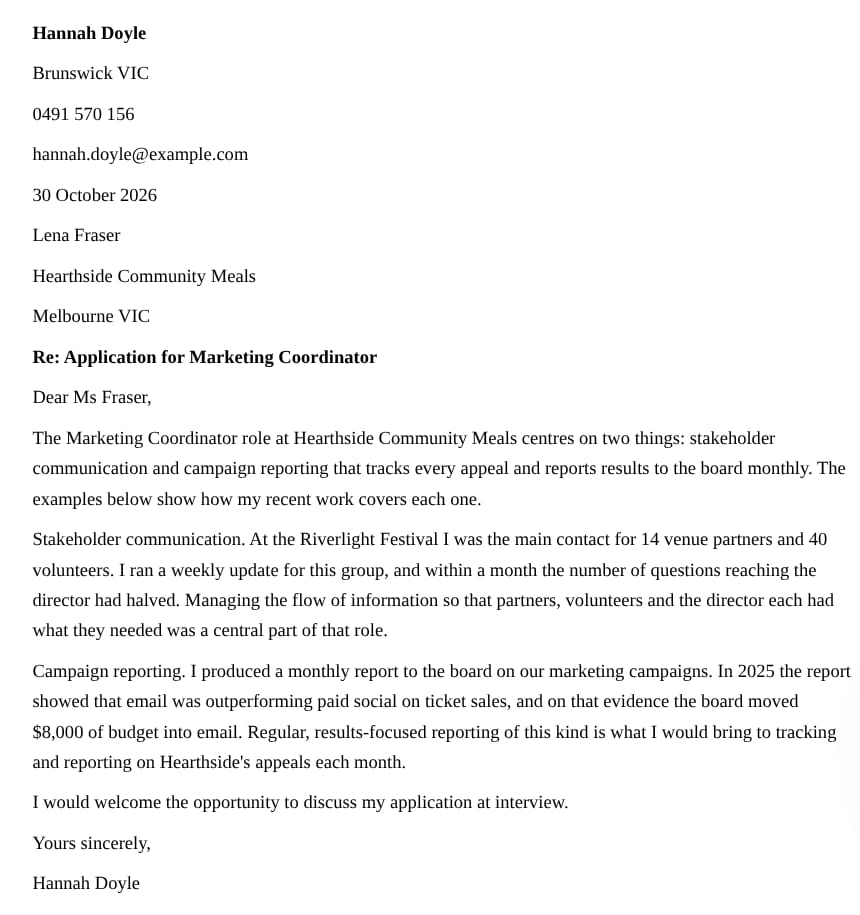
It came back as a one-page A4 Word file with a 178-word body. The header has the four details from earlier in this post and no street address. Each criterion gets its own paragraph, opened with the ad's own words, and every number in them is one we gave it: 14 venue partners, 40 volunteers, questions halved in a month, $8,000 moved to email.
It took two follow-ups in the same chat. The first draft opened with "I am writing to apply for", so we asked for an opening that names the role and both criteria. That version said Hannah had worked with donors and partner cafes, which she hadn't, so we asked it to stick to what she did. Each fix was one message, and the file kept its earlier versions. Read your draft against your own facts the same way before you send it.
To build one from a real posting, the free cover letter generator takes the posting and your background and returns an editable Word file, or a PDF if you ask. It's instructed to use only the background you give it, so a thin background gets a shorter letter, not invented experience. Read it before you send it anyway.
The internship version
The structure stays the same. What changes is where the proof comes from. SEEK's internship cover letter guide suggests 250 to 400 words on one page, and says that with little paid experience you can draw on university projects, volunteer work or personal initiatives.
So a group assignment where you ran the survey and presented the findings counts. So does running the socials for a uni club. Answer the ad's criteria with those, in the same STAR shape. The "why them" paragraph matters more here, because an internship is partly about what you'll learn: tie it to something specific the organisation does. Close by thanking them and saying when you're available to interview.
Mistakes that get a letter skipped
- One letter for every job. JobAccess says to tailor the letter to the job and organisation and not send the same letter for every job.
- Your resume, retold. The letter picks two things and explains them. The resume lists everything. To make the two agree, the AI Resume Tailor rewrites your resume against the same ad, using the posting's language where it's true.
- A second page. If it doesn't fit, cut the weaker proof point, not the margins.
- Claims you can't back up. Anything in the letter is fair game in the interview.
- Typos. SEEK's advice is to triple check spelling and grammar, or get someone with a keen eye to read it.
Write the letter after you've read the ad twice
Most of the work happens before you write a word. Read the ad until you can name what it cares about most, and find out who will read your letter. A letter built from that reads like it was written for that job, because it was.