askROI Blog
UK CV format: what to include, and when to say resume instead
The UK CV format: a short profile, your work history newest first, and no photo or date of birth, plus when the same document is called a resume instead.
By askROI ·

Try it
Say what you do now and what you want to move into, and askROI writes the CV as a Word file you can edit. Change the jobs and skills in the prompt to your own.
Opens a new chat with a message you can edit before sending
The usual UK CV format is simple: contact details, a short personal profile, your work history with the newest job first, education, and nothing about your age, marital status or looks. Most people keep it to two pages.
If you're applying from abroad, the part that catches people out is the word itself, and what you leave off.
CV or resume: which word each country uses
The document is much the same. The name and the usual length change.
| Country | Word | Usual length |
|---|---|---|
| UK | CV | About two pages |
| Australia | Resume | 1 to 3 pages |
| Canada | Resume | Up to two pages |
The Queensland government and Canada's Job Bank state those lengths directly. The UK's National Careers Service doesn't set one, so two pages there is a convention rather than a rule. (Pages checked 6 November 2026.) Elsewhere, use the word the job advert uses. If you need a resume for a US or Australian employer, the resume builder writes to that format.
What goes on a UK CV, section by section
The National Careers Service lists these sections:
- Contact details. Your name, phone number and email. A professional profile such as LinkedIn is optional.
- Introduction, or personal profile. A short summary under your name: what you do, what you're good at, what you want next.
- Work history. Employer, job title, dates and what you did, with the most recent first.
- Education. Qualifications, where you studied and when. If you're early in your career, this can come before work history.
- References. Optional. The service suggests saying they're available on request, rather than listing anyone's contact details.
Under each job, say what changed because you were there, with a number if you have one. "Trained 12 new starters" tells an employer more than "responsible for training".
What to leave off, and why
The National Careers Service is plain about this: "You should not include your age, your date of birth, whether you're married or your nationality."
The reason is the Equality Act 2010, which makes age, race including nationality, and being married or in a civil partnership protected characteristics in UK law, along with sex, disability, religion or belief, sexual orientation, gender reassignment and pregnancy. A CV without those details lets an employer shortlist you on your work. For the same reason, skip the photo: it shows the reader several of those things before they've read a word.
Tailoring it to one job advert
A CV sent everywhere reads like it. Before each application:
- Read the advert and underline the skills it asks for.
- Put those skills in your personal profile, in the employer's own words where they're true.
- Reorder the bullet points under each job, so the most relevant comes first.
If you're changing fields, name the skills that carry over. A cover letter is where you explain the move, and the cover letter generator can draft one from the same details.
A finished example
We sent the Try it prompt and got a Word document with a personal profile, a table of transferable skills, and employment history, with British spelling and no photo or date of birth.
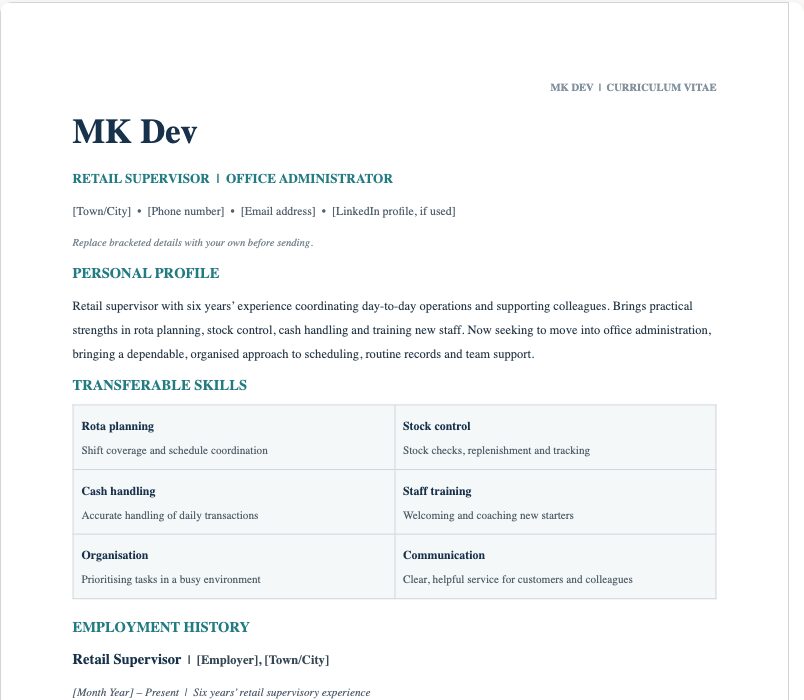
Notice what it didn't do. We gave it no employer, no dates and no qualifications, so it left clearly marked gaps such as [Employer] and [Qualification or course] instead of inventing them, and it told us to fill them in before sending. The name at the top came from the test account we were signed in with, so check that too.
Treat it as a first draft. It writes the shape well, and the numbers and specifics have to come from you. Add the rota you ran, the size of the team and the stock you counted, then use Make it shorter or ask for a change in the same chat if it runs past two pages.
Read it through once as if you were the hiring manager with thirty others to get through. If the first third of page one doesn't tell you why this person suits this job, that's the part to rewrite.