askROI Blog
CV format for Nigeria and Kenya in 2026, with a sample
The CV format Nigerian and Kenyan job sites recommend in 2026: length, the sections in order, NYSC and referees, what to leave off, and a chat that writes yours.
By askROI ·

Try it
Tell askROI your degree, your NYSC year and the job. The button opens a chat with a Lagos graduate's request already filled in; it asks for your details before it writes.
Opens a new chat with a message you can edit before sending
The big job sites in Nigeria, Kenya and Uganda all call it a CV, and the CV format they recommend comes down to the same few rules: one or two pages, plain sections in a clear order, and fewer personal details than many older templates carry. The AI resume builder builds one in that shape from your details.
Below: what the job sites in each country say about length and sections, how to handle NYSC and referees, what changed for 2026, and what askROI makes from the Try it prompt.
Length: one or two pages
Nigeria's guide sets a two-page maximum; the Kenyan and Ugandan guides call one to two pages typical, depending on experience:
- Nigeria: "Keep CV length to a maximum of two pages" (Jobberman, CV writing, updated 27 October 2026, checked 30 October 2026).
- Kenya: "Aim for a CV that is typically one to two pages long, especially if you're early in your career" (BrighterMonday Kenya, updated 22 September 2025, checked 30 October 2026).
- Uganda: BrighterMonday Uganda puts most CVs there at one to two pages, depending on experience (BrighterMonday Uganda, updated 19 November 2025, checked 30 October 2026).
A fresh graduate rarely needs the second page. If yours spills over, cut school activities before work you were paid or graded for.
The sections, in order
This is a suggested order for an early-career CV, not one the guides prescribe: with little work history, education goes first. Jobberman and BrighterMonday Uganda put experience before education, which suits you once you have work to show. Either way, the job ad's own instructions come first.
- Personal details: your name, phone number, email and city, plus a LinkedIn link if you keep it current.
- Profile: two or three lines on your degree, the role you want and what you bring to it.
- Education: degree, university and year; add your KCSE or WAEC result only if the job ad asks for it.
- NYSC (Nigeria): see below.
- Experience: newest first, with two or three lines each on what you did and a number where you have one.
- Skills: the tools and skills the job ad asks for, if you have them.
- Referees: see below.
NYSC and referees
NYSC in Nigeria. Some Nigerian applications ask about it directly. Miva Open University notes that "some organisations won't even let you complete your job application without entering your NYSC certificate number or uploading your certificate" (Miva Open University, 3 March 2026, checked 30 October 2026). Put your NYSC status and year where a recruiter will see it, either as its own short section or in your education block: completed, exempted or in progress, with the year.
Referees. Nigeria: "Most Nigerian employers request two to three referees" (Jobberman). Kenya: Corporate Staffing Services says "if asked to provide referees, chose at least three people" (Corporate Staffing, referees, checked 30 October 2026). Uganda: "It's now acceptable to write 'Referees available on request' unless the employer asks for names" (BrighterMonday Uganda). Ask each referee before you list them, and give a phone number and email that they actually answer.
What changed for 2026
- No photo unless asked. Corporate Staffing tells Kenyan applicants to remove "your ID number, your photo, your marital status and your religion" (Corporate Staffing, October 2026, checked 30 October 2026). In Uganda, "a CV photo is optional," included "only when the employer requests it or the job is public-facing."
- Fewer personal details. Jobberman says to leave off "outdated details like religion, state of origin, or multiple phone numbers unless specifically requested in the job posting." BrighterMonday Kenya says the same of "marital status, religion, or age."
- Software reads it first. Jobberman runs its own applicant tracking system, which stores the CVs applicants upload (Jobberman help centre, checked 30 October 2026), and BrighterMonday Uganda says "most medium and large employers now screen CVs using ATS tools." BrighterMonday Uganda's advice for getting through it is clear headings and no graphics.
What askROI made from the Try it prompt
We sent the Try it prompt as written, as a made-up graduate, Tobi Adeyemi. askROI asked for the details first; we gave it a degree, an NYSC posting, an internship, a project, skills and two referees. It came back with a one-page Word file, inside the two-page limit, with the sections in the order the prompt asked for:
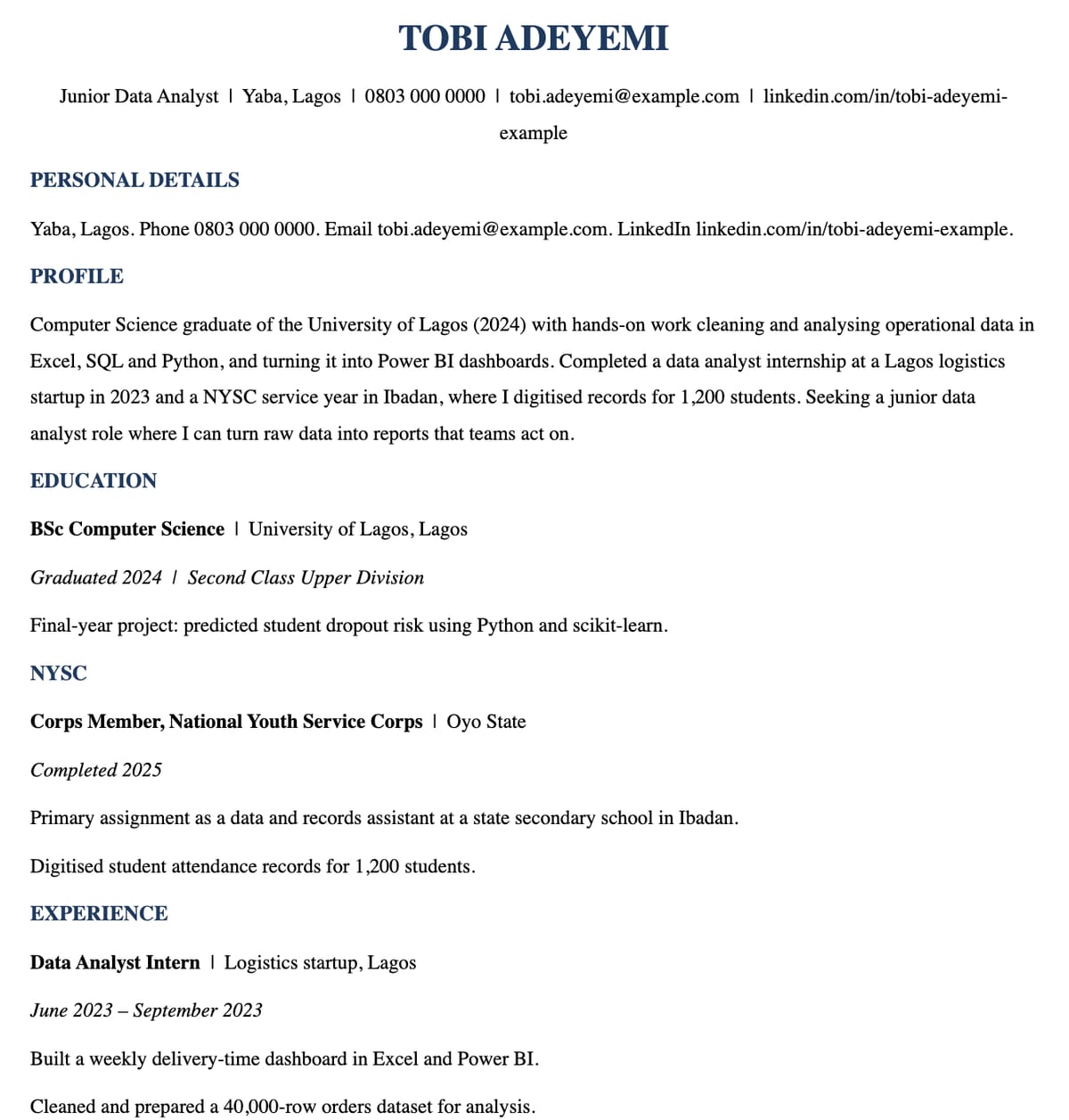
It also listed what was still missing before sending: the internship company's real name, the NYSC batch and place of primary assignment, and referee emails. And it noted that some Nigerian CVs add date of birth, state of origin or marital status, but left them out because we did not give them, which matches Jobberman's advice to skip them unless the job ad asks. Change the degree, the NYSC year and the role in the prompt to yours. To go with it, the free cover letter generator writes the application letter many employers ask for.
A good CV for Lagos or Nairobi in 2026 is short, plain and current. One or two pages, the sections recruiters look for, and nothing they would have to skip past.