askROI Blog
How to write a reaction paper: format, outline and a sample
How to write a reaction paper in three parts, how it differs from a reflection or a review, and a sample on Rizal's letter to the women of Malolos.
By askROI ·

Try it
Name the reading, then bring your own reactions. The button opens a chat about José Rizal's letter to the young women of Malolos that asks you for one point you agree with, one you doubt and one question before it drafts anything; change the text and the length to match your assignment.
Opens a new chat with a message you can edit before sending
Learning how to write a reaction paper comes down to two things: show that you understood the material, then say what you think of it and why. The second part is where most papers go wrong, because a reaction is only as good as the specific points it hangs on.
Below: what a reaction paper is, the three-part format, how to build a reaction you can defend, a sample, and how to use a generated draft honestly.
What a reaction paper is, and what it is not
Hunter College's writing center sums up the assignment: "your instructor will most likely expect you to do two things: summarize the material and detail your reaction to it" (Hunter College Reading/Writing Center, checked 2 November 2026).
- A review judges the work itself: is it good, well argued, worth reading. Bishop's University's writing centre contrasts writing "about your experience" of a text, a reaction, with "a critical review" of it (Bishop's University Writing Centre, checked 30 October 2026).
- A reflection is broader: the University of Toronto Scarborough library describes reflective writing as drawing "on your own experience," and lists a reaction paper as one form it can take (UTSC Library, checked 30 October 2026).
So a reaction paper is a focused kind of reflection: your response to one specific text, tied to what that text actually says.
The three-part format
- Summary. One paragraph: who wrote it, when, to whom, and the main points. Hunter's advice is to "keep the summary objective and factual," with none of your opinion yet.
- Reaction. Usually the longest part, often two or three paragraphs. Each takes one point from the text, says whether you agree, disagree or have a question, and explains why.
- Conclusion. One paragraph on what the text changed in how you think, or what it left you wanting to know.
Length and citation style vary by course: some ask for a page, others for three or more. Use the length and the citation style your syllabus or course guide sets.
How to build a reaction you can defend
Start each reaction paragraph from a specific line or idea in the text, not from your general opinion. Then do one of three things with it:
- Agree, and add a reason or an example the author did not give.
- Disagree, and say which part does not hold and why.
- Question, and say what the text leaves open.
Bishop's notes that in a reaction you are usually allowed to use "I", so write in your own voice. What separates a strong paper from a weak one is that every opinion points back to something on the page.
A sample: Rizal's letter to the young women of Malolos
Rizal wrote the letter in Tagalog in 1889, to the young women of Malolos. The original is public domain, and you can read it on Project Gutenberg (checked 30 October 2026); your course may assign a particular English translation, so quote from that one.
The Try it button above asks askROI to collect your three reactions first, then shape them into a two-page paper in the three-part format: one paragraph of summary, three of reaction tied to specific lines, and one of conclusion, as a Word document.
We sent that prompt as a made-up student, Andrea Cruz. askROI asked for the three reactions before writing anything. We gave it one point of agreement (education as the way out of servitude), one doubt (the letter frames women's learning around men) and one question (how the women of Malolos responded). It returned a two-page paper in that shape, with an APA reference list:
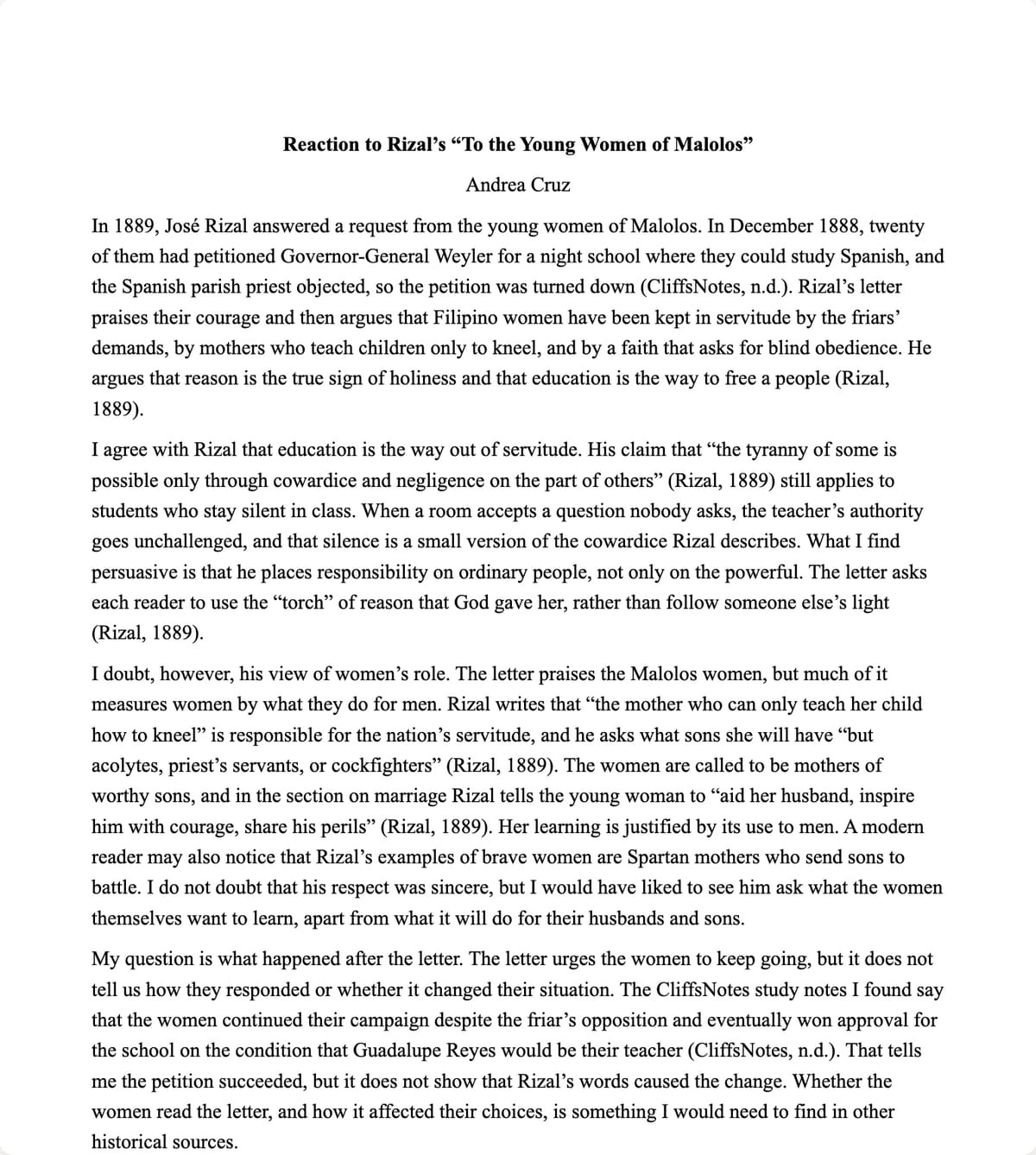
This is the agreement paragraph, built from the student's note and tied to a line from the letter. The words inside the quotation marks come from an English translation that names no translator, as askROI pointed out below, so in your own paper quote the translation your course assigns:
I agree with Rizal that education is the way out of servitude. His claim that "the tyranny of some is possible only through cowardice and negligence on the part of others" (Rizal, 1889) still applies to students who stay silent in class. When a room accepts a question nobody asks, the teacher's authority goes unchallenged, and that silence is a small version of the cowardice Rizal describes.
It also told us what to check before handing it in: the English text it quoted names no translator, so the instructor may want a named translation or the original cited. For the question, the sources it found did not say whether the letter changed anything for the women, so the paper says that plainly and leaves the question open.
Use a generated draft honestly
A generated reaction paper is a model of the shape, not your paper. Your reaction has to be yours: your agreement, your disagreement, your questions.
Check your school's rules first. De La Salle University, for example, requires students to attach "a written disclosure statement" whenever generative AI was used in a submission, naming the tool and describing how it was used, and it treats a missing disclosure as academic dishonesty (DLSU generative AI policy, from Term 1 2025-2026, checked 30 October 2026). Check your own school's policy before you use any tool.
To prepare, summarise the reading first with the PDF summarizer, then write your reaction from your own notes. For the final file, the AI document generator formats a draft into a Word document.
A reaction paper rewards one habit above everything else: every time you say what you think, point to where in the text it comes from.