askROI Blog
Is it legal to use an AI note taker? Consent by country
Is it legal to use an AI note taker? Who has to agree in the US, UK, Canada and Australia, and a notice you can paste into your meeting invites.
By askROI ·

Try it
The button asks askROI for two short invite notices: one for a client call with someone in California, one for a team meeting in the UK. Change the details to fit your calls and send it.
Opens a new chat with a message you can edit before sending
You want an AI note taker in your client calls, and someone on the team asks the obvious question: is it legal to use an AI note taker? Recording a meeting without consent is a crime in some places and fine in others, and on a video call your attendees can be in three of them at once.
Below is what the law says about AI note taker consent in the US, the UK, Canada and Australia, with links to the statutes and regulators we read on November 6, 2026. This is general information, not legal advice. If a call carries real legal risk, ask a lawyer where you and your attendees are.
The short answer
Under US federal law and Canada's Criminal Code, one person on the call agreeing is enough, and that person can be you. California and New South Wales ask for more, and UK data protection law asks you to tell people what you record and why. The habit that holds up in all of them: say it in the invite, say it again when the call starts, and turn the note taker off when someone asks.
United States: one person is enough federally, everyone in California
Federal wiretap law allows a person who is a party to a call to record it, or anyone to record it when one of the parties has given prior consent, unless the recording is made to commit a crime or a tort (18 U.S.C. § 2511(2)(d), checked November 6, 2026).
States have their own wiretap laws, and some set a higher bar. California makes it a crime to record a confidential communication without the consent of all parties, punishable by a fine of up to $2,500 per violation for a first offense (up to $10,000 for someone with a prior conviction under the state's eavesdropping laws), jail or prison time, or both. A conversation counts as confidential when the circumstances reasonably suggest someone on it wants it kept between the people there (Penal Code § 632, checked November 6, 2026).
We haven't checked every state, so look up your own state's code before you rely on the federal rule. When people join from several states, the safe choice is to get everyone's agreement, which is also the easiest thing to do: ask at the start.
United Kingdom: tell people what you record and why
The UK's data protection rules don't cover a purely personal or household activity (UK GDPR Article 2(2)(a), checked November 6, 2026). If you record calls for work, plan as if the rules apply. A recording and transcript of named people is information about identifiable people, which is what the law calls personal data (Article 4(1)).
When you collect personal data from the people it is about, Article 13 says you tell them at the time: who you are, why you are collecting it and on what legal basis, who receives it, and how long you keep it (UK GDPR Article 13, checked November 6, 2026). The ICO's guidance on the right to be informed says the same in plain terms, and asks for that information to be concise, easy to reach and in clear language. An invite notice is a natural place to give it.
Canada: the Criminal Code, then PIPEDA for businesses
Under the Criminal Code, knowingly intercepting a private communication with a device is an offence with up to five years in prison, but it doesn't apply to someone who has the express or implied consent of the person speaking or of the person they meant to hear it (Criminal Code s. 184, checked November 6, 2026). So a participant can agree to their own call being recorded.
Businesses also answer to PIPEDA, which covers private-sector organizations collecting personal information in the course of commercial activity. Alberta, British Columbia and Quebec have their own private-sector laws that generally apply instead to personal information handled within those provinces, but PIPEDA still covers federally regulated businesses and personal information that crosses provincial or national borders (PIPEDA in brief, checked November 6, 2026). The Privacy Commissioner's guidance on recording customer calls says to tell the person you are recording, state the purpose as clearly and narrowly as you can, and get consent. Someone who carries on knowing why the call is recorded has usually given implied consent, and when recording isn't needed to provide the service, people should get a choice.
Australia: it depends on the state
Each state and territory has its own surveillance devices law, and they differ. Two examples:
- New South Wales bars recording a private conversation even when you are part of it, unless all the principal parties agree, or one of them agrees and the recording is reasonably necessary to protect their lawful interests or isn't made to share with people outside the conversation. The maximum for a person is 100 penalty units, five years in prison, or both (Surveillance Devices Act 2007, s. 7, as summarized by the NSW Department of Communities and Justice, October 2025, checked November 6, 2026).
- Victoria bars recording a private conversation you are not part of without each party's consent (s. 6), and separately bars passing on a record or report of a private conversation made with a listening device unless each party agrees or another exception applies (s. 11). That second rule matters if you send the notes to anyone (Surveillance Devices Act 1999, version 048, checked November 6, 2026).
If your team or clients are in another state or territory, read that one's act before you rely on either example.
What askROI's note taker tells the people on the call
When askROI joins a Zoom, Google Meet or Teams call, it shows up under a name that says whose notes it takes: by default your first name and "notes (askROI)", for example "Sam's notes (askROI)", or "askROI Notetaker" when your account has no name. You can also pick your own. As it joins, it posts a message to everyone in the meeting chat and pins it:
Sam's notes (askROI) is recording and transcribing this call for Sam Lee. Ask them to remove it if you do not want to be recorded.
On Zoom, the host also has to allow recording when askROI asks. If someone objects, Stop recording in askROI takes it out of the call (unless a teammate is recording the same call with it). Not everyone reads the meeting chat, so say it out loud too. After the call you get notes with a short summary, topics, decisions and action items; for a meeting you didn't record, the AI meeting minutes generator writes them up from what you paste in.
A notice to paste into an invite
Here is what askROI wrote from the Try it prompt, on a test account. Both versions came in under 80 words.
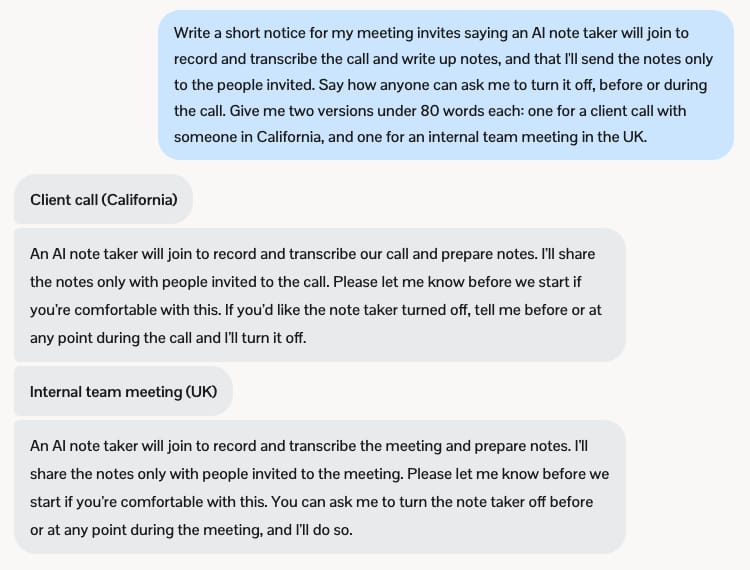
Client call (California): An AI note taker will join to record and transcribe our call and prepare notes. I'll share the notes only with people invited to the call. Please let me know before we start if you're comfortable with this. If you'd like the note taker turned off, tell me before or at any point during the call and I'll turn it off.
Both ask for an answer before the call starts, which is what an all-party state needs. In the UK, treat the invite text as the short first layer of your notice, not the whole of it: link it to your full privacy notice, which has to give your contact details, the legal basis for recording, how long you keep the notes, people's rights over them and how to complain to the ICO, as Article 13 requires.
Laws change and every call is different, so treat this as general information, not legal advice. The part that doesn't change is the habit: say it in the invite, say it at the start, and stop when someone asks.