askROI Blog
Income statement, balance sheet and cash flow
The three financial statements are one set of numbers seen three ways. Build them from raw figures, then use each one to check the other two.
By askROI · · Updated

Try it
Paste two periods of figures and askROI lays out all three statements, checks that they tie, and flags what needs a second look. The button fills in a design studio's third quarter, so you can swap in your own numbers.
Opens a new chat with a message you can edit before sending
A bank, an investor or a grant form asks for "financial statements", and what you have is a bookkeeping export, a folder of invoices and a bank balance. That's enough. The three statements are the same numbers arranged three ways, and because they share numbers, each one checks the other two.
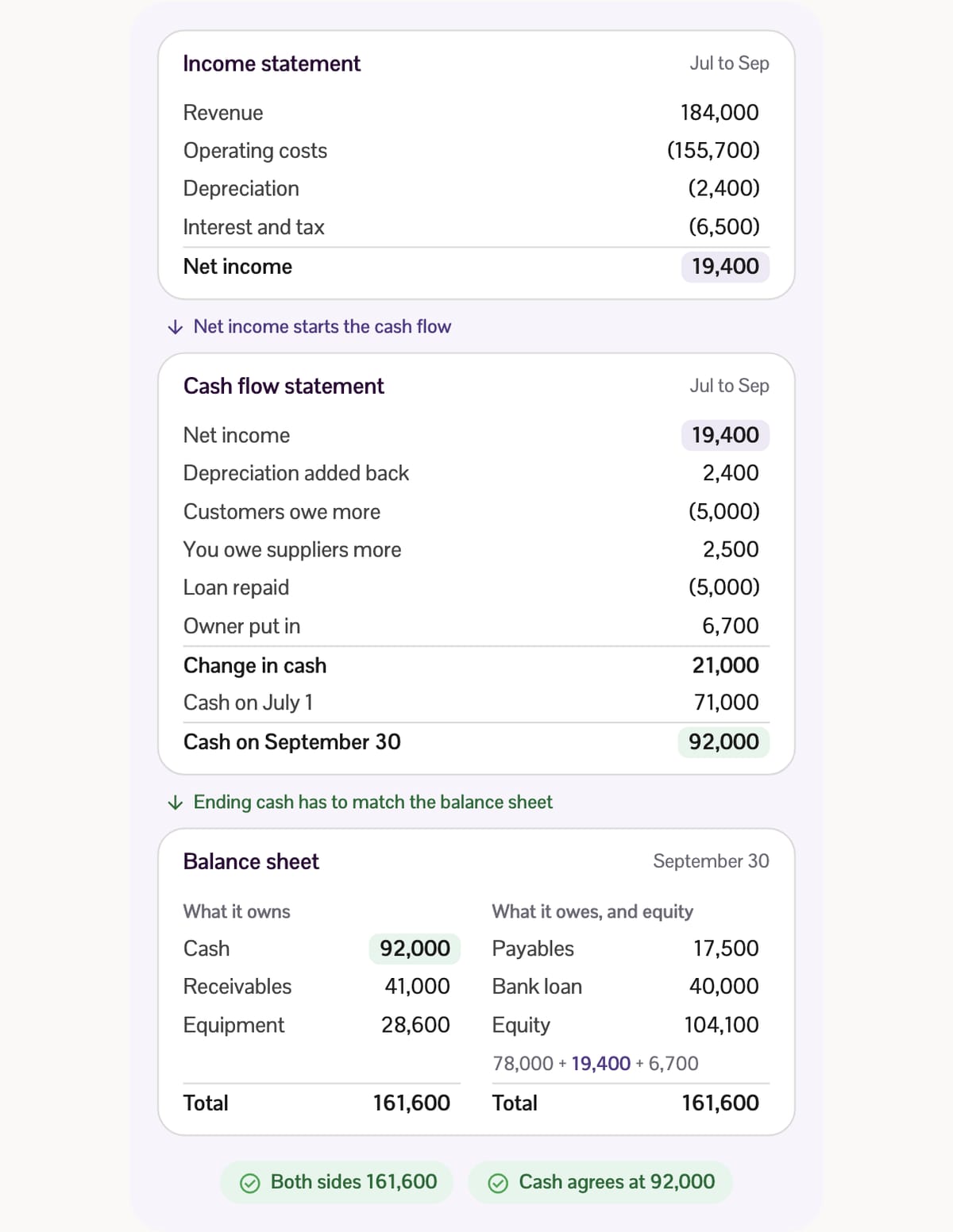
Here's the idea in one quarter of a small design studio. Watch two figures: net income and the cash at the end. Each one lands in a second statement, and if the books are right, it lands on exactly the number that's already there.
Two kinds of numbers go in
Gather two kinds of figures, for the period you're reporting and the one before it.
- What happened during the period: revenue, each kind of cost (contractors, salaries, rent, software, marketing), depreciation, interest and tax.
- Where things stood on the last day: cash in the bank, what customers owe you (receivables), equipment and other assets, what you owe suppliers (payables), and loans.
Then add the line people forget: any money the owner put in or took out. The balances can't tell you about it, and if you leave it out, the statements won't tie, as you'll see below. You don't need an equity figure. It falls out of the balance sheet on its own.
The income statement covers a stretch of time
The income statement covers a period, here July to September. Revenue goes at the top, costs below it, net income at the bottom. Put the previous quarter beside it, because the change is where the story is. Brackets mean money going out. The last column compares each line with April to June: a plus helped profit, brackets hurt it.
| Q3 | vs Q2 | |
|---|---|---|
| Revenue | 184,000 | +22,000 |
| Operating costs | (155,700) | (9,700) |
| Depreciation | (2,400) | 0 |
| Operating income | 25,900 | +12,300 |
| Interest | (900) | +100 |
| Income tax | (5,600) | (2,400) |
| Net income | 19,400 | +10,000 |
Revenue grew 13.6% while operating costs grew 6.6%. Rent and salaries, 82,000 a quarter between them, didn't move at all, so most of the extra revenue fell straight through to profit, and net income more than doubled, from 9,400 to 19,400. Operating margin went from 8.4% to 14.1%. That's the sentence a reader of these statements wants, and it only exists because the two quarters sit side by side.
The balance sheet is a single day
The balance sheet is a photo of September 30: what the business owns on one side, what it owes plus the owner's share (equity) on the other. The two sides are equal by definition, which is why you can leave equity blank. Here, 161,600 of assets minus 57,500 of liabilities leaves 104,100 of equity, up from 78,000 at the end of June.
That definition has a catch. When equity is the balancing figure, the balance sheet always balances, typos and all. On its own it proves nothing. The check that can actually fail is the next statement.
The cash flow statement explains the bank balance
Profit isn't cash. A customer who hasn't paid yet counts as revenue but not as money in the bank, and depreciation lowers profit without a cent leaving the account. The cash flow statement walks from one to the other, usually by what accountants call the indirect method:
- Start with net income: 19,400.
- Add back costs that weren't cash, here 2,400 of depreciation.
- Adjust for working capital. Customers owe 5,000 more than they did in June, which is cash you haven't collected, so subtract it. You owe suppliers 2,500 more, which is cash you haven't paid out yet, so add it. That makes 19,300 from operations.
- Add investing and financing. Equipment fell by exactly the depreciation, so nothing was bought. The loan went down by 5,000, and the owner put in 6,700.
That's 21,000 more cash. The quarter started with 71,000, and 71,000 plus 21,000 is 92,000, the number on the balance sheet. Equity agrees too: 78,000 plus 19,400 of profit plus the owner's 6,700 is 104,100. When every one of those lines up, the statements tie.
When they don't tie, the gap points at the problem
Break the example on purpose. Pick a mistake below and see which check catches it.
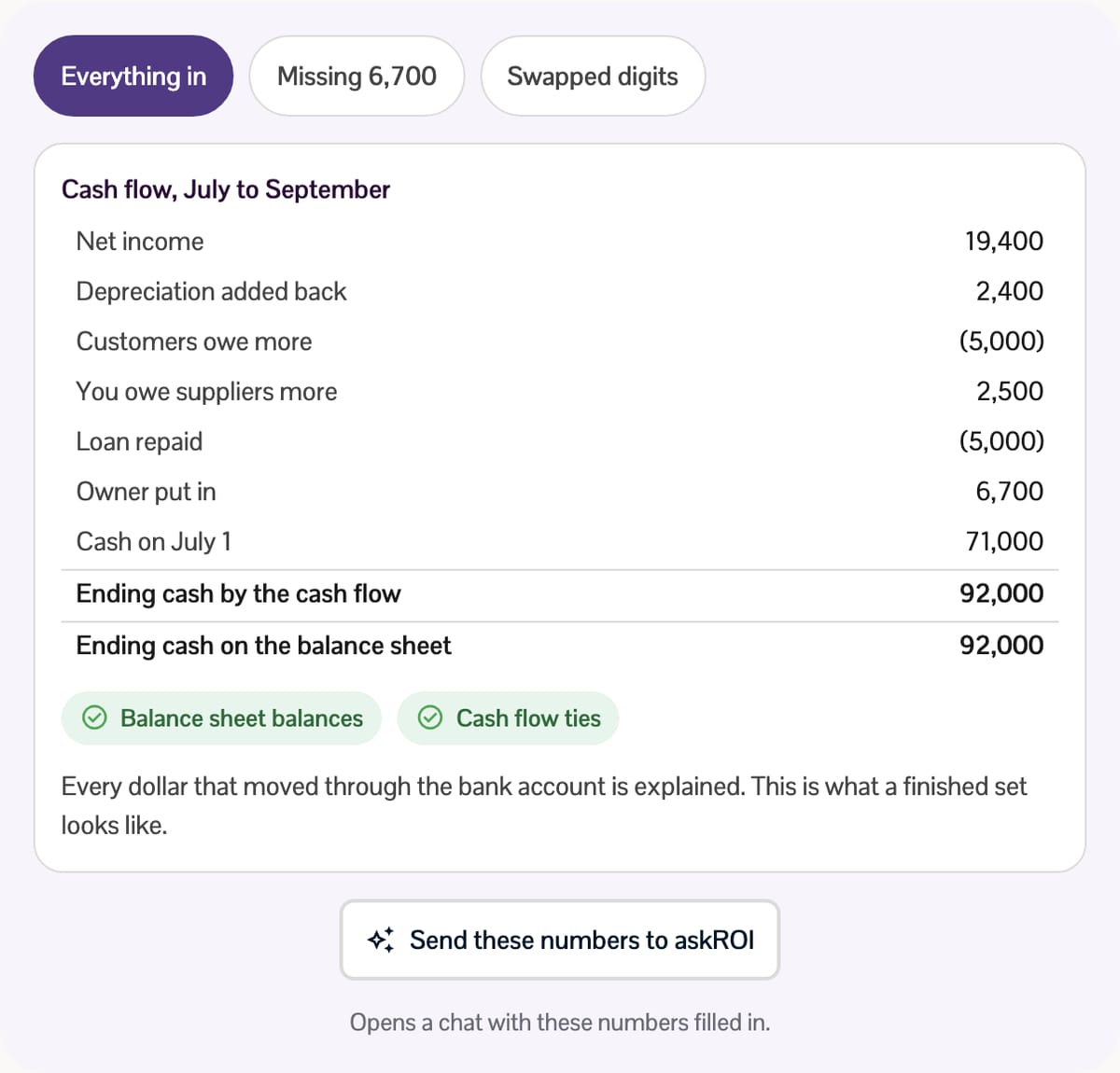
The size of the gap is a clue. A gap equal to a figure you know about, like the owner's 6,700, points straight at it. A gap that divides evenly by 9 can mean two swapped digits, because swapping any two digits changes a number by a multiple of 9.
We gave askROI the middle version, every number except the owner's 6,700. It built all three statements, and its cash flow carries a line called Owner contribution (implied) for exactly 6,700. Then it said the important part out loud: because equity is the balancing figure, the tie doesn't prove the 6,700 is real.
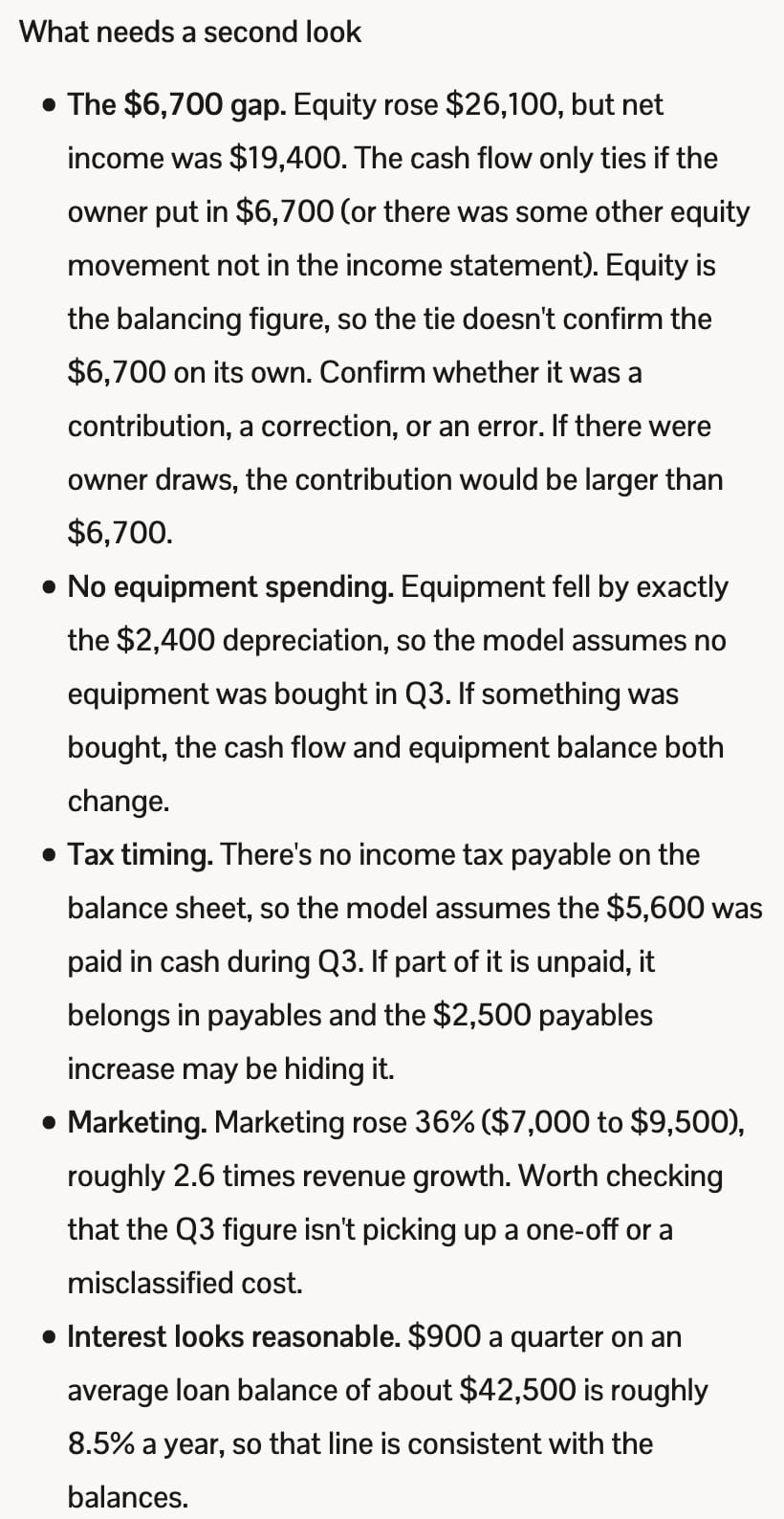
The rest of the list is what a careful bookkeeper would ask, and every point names the numbers behind it. Equipment fell by exactly the depreciation, so nothing was bought. There's no tax payable on the balance sheet, so the 5,600 of tax is assumed paid. Marketing grew 2.6 times as fast as revenue. And 900 of interest on a loan averaging 42,500 works out to about 8.5% a year, which fits.
What comes back from askROI
The financial statement generator lays the statements out as tables in the chat: the income statement with both periods side by side and the margins, then the balance sheet and cash flow statement when you ask for them, and the flags underneath. It works only from the figures you give it and says what it couldn't build: in the run above, with no balances from before April, it skipped a Q2 cash flow and told us why. Give it no figures at all and it asks for them instead of making any up.
Ask for a spreadsheet in the same chat and askROI builds an Excel workbook where the totals are formulas, so correcting one input updates everything that depends on it. The workbook opens in the chat, where you can read every sheet, change a cell with Edit, or ask for a change in plain words.
Statements going to a lender or a tax office should still get a look from an accountant. Arriving with three statements that tie and the flags already looked into makes that a shorter conversation.
Three statements, one set of books. When they disagree, don't adjust a total until it looks right: go back to the raw numbers, and let the size of the gap tell you where to start.