askROI Blog
Model Council: three AI models, one checked answer
One message goes to three models from different labs. A judge that wrote none of the answers shows where they agree and split, and you get one final answer.
By askROI · · Updated

Try it
Send Model Council a plan you want someone to argue with. This button opens a new chat with Model Council already switched on.
Opens a new chat with a message you can edit before sending
You ask an AI something that matters, and you get back a smooth, confident answer. Is it right? You can't tell from the answer itself. A wrong answer sounds exactly as sure of itself as a right one.
So you ask a second model. Then a third. Now there are three tabs open and you're comparing paragraphs by hand, trying to work out which parts they agree on. Model Council does that comparison for you, in one chat.
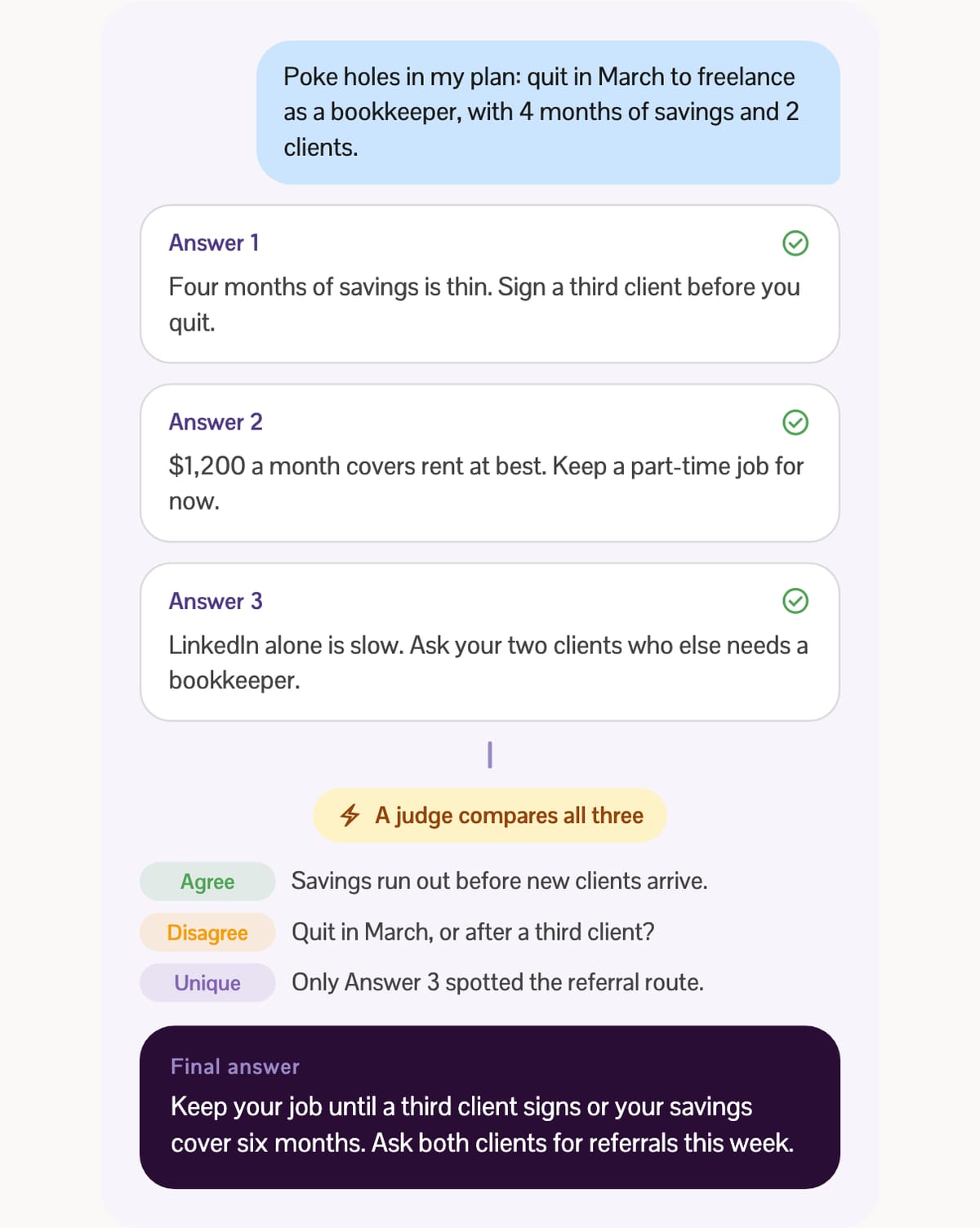
Three models from three different labs
A council is three models made by three different companies. That's on purpose. Models trained by different teams, on different data, tend to trip over different things, so their mistakes don't line up. When all three agree, you can lean on the answer. When one breaks from the others, that's the sentence worth reading twice.
The lineup today:
- Standard: Claude Haiku 5.5, GPT-6 Luna and GLM 5.3 Flash
- Premium: Claude Haiku 5.5, GPT-6.2 Sol and GLM 5.3 Flash
We swap models in as better ones ship, and this page always shows the current lineup.
What comes back
Each answer gets its own tab, Answer 1, Answer 2 and Answer 3, and the tabs fill in as each model finishes. They're numbered rather than named, so you read each answer for what it says.
Under the tabs, a synthesis panel lays out:
- Where answers agree, the part you can mostly trust
- Where answers disagree, the part to think about yourself
- Unique discoveries, the thing only one model noticed
Then you get one final answer that keeps the strongest parts of all three.
The judge wrote none of the answers
The comparison is done by GPT-6 Luna Pro, which sits outside the council, so it never grades its own homework. That matters most when you ask for a file. Ask a council for a slide deck, a PDF or a logo, and each model makes its own version. The judge opens all three, marks the strongest one Best, and tells you why it won.
The final answer is written by Claude Haiku 5.5 in Standard and GPT-6.2 Sol in Premium, working from the three answers and the judge's notes.
When a council is worth the credits
A council runs three answers plus a comparison and a final write-up, so it uses a lot more credits than a normal message. Save it for questions where a second and third opinion change what you do next. Pick one below to see the kind of question that earns it.
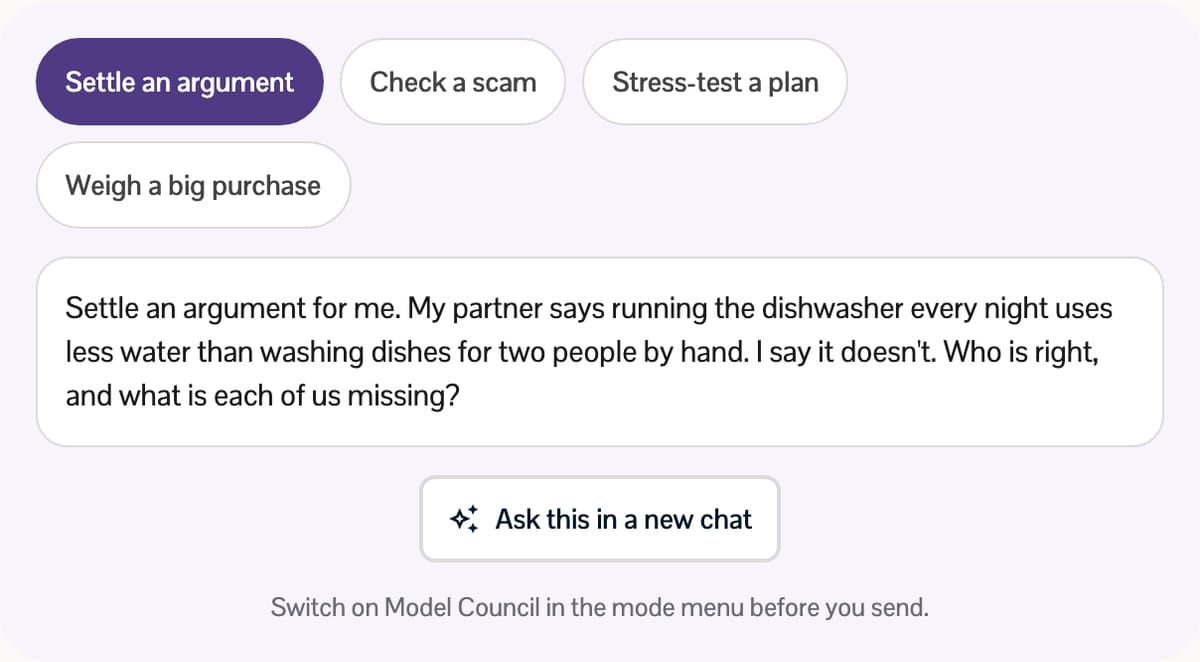
If you only want one clear recommendation on a decision, the decision matrix is faster and cheaper. You can also start a council from the Model Council card on the create screen. It needs a free account, and it isn't offered in group chats, which send one answer to everyone.
Developers have been doing this for a while
"LLM council" projects have been around in open source for a while: send one question to several models, then have a chairman model merge the replies. They work well. They also need an account and an API key with every provider, and you read the results in a terminal. Model Council is the same idea in an ordinary chat, with the lineup picked and kept current for you.
One model gives you an answer. Three models from different labs, checked by a judge that wrote none of them, also tell you how much to trust it.