askROI Blog
How to write a business plan for a small farm or shop
How to write a business plan a lender can read: the eight sections, the numbers, and a poultry business plan example for Nigeria, Kenya and Uganda.
By askROI ·

Try it
Tell askROI about your business and it asks you a few questions, then writes the plan as a Word document and the numbers as an Excel file. The button fills in a broiler farm in Ibadan; change the details to yours before you send.
Opens a new chat with a message you can edit before sending
You want a loan, a grant or a partner, and the first thing they ask for is a business plan. If you have never written one, it can feel like a test you did not study for. This guide shows how to write a business plan for a small farm or shop: the eight sections a reader expects, a financial table they can check, and a draft you can finish in an afternoon. The running example is a small broiler farm, so you also get a poultry business plan you can adapt.
Write the summary and the numbers first
The people who decide on your money read a lot of plans. Write as if they will read two parts closely, the executive summary and the financial plan, and skim the rest, because many do.
So start there. In a few sentences, the summary says what you sell, who buys it, how much money you need, what it pays for and how it comes back. The financial plan shows the same story in figures. Everything else in the plan exists to make those two parts believable.
The eight sections, with a poultry farm
A plan for a small business does not need fifty pages. It needs eight sections that each answer one question. Here is what each one holds for a 500-bird broiler farm:
| Section | What it says for the farm |
|---|---|
| Executive summary | A broiler farm near Ibadan selling 500 birds a cycle to market traders and restaurants, asking for 3,000,000 naira for housing, feeders and the first flock. |
| Business description | Who owns it, where it is, when it started or will start, and whether it is registered. |
| Market | Who buys broilers nearby, what they pay, how often they buy and who else sells to them. |
| Products and services | Live birds, dressed chicken, and anything extra such as manure sold to crop farmers. |
| Operations | How a cycle runs: day-old chicks, feed, vaccination, labour, water, power and how birds reach buyers. |
| Management | Who does the work and what experience they bring, including anyone who advises you. |
| Financial plan | Startup costs, monthly cash flow and three years of projections, with the assumptions written out. |
| Funding request | The amount, what each part pays for, and how and when the money is repaid. |
A shop works the same way with different nouns: stock instead of chicks, rent instead of housing, suppliers instead of hatcheries. The AI business plan generator starts from whatever business you describe and builds the plan as a Word document you can edit.
Make the numbers add up
The financial plan needs three tables: startup costs (what you spend before the first sale), a monthly cash flow (money in and out each month for at least the first year) and projections for three years. The cash flow matters most, because it shows the month the money runs out.
That month showed up in our example. From a few sample answers, askROI built an Excel workbook with sheets for assumptions, startup costs, profit and loss, monthly cash flow and sensitivity, all worked out with formulas. In the cash flow, the 3,000,000 naira arrives in December 2026, repairs and equipment take 2,420,000 over two months, and the first flock plus that month's running costs come to 3,064,000 in February. The balance falls to minus 2,484,000 naira before the first birds sell in March, so the sheet adds up how much more the farm needs: 2,784,000 naira.
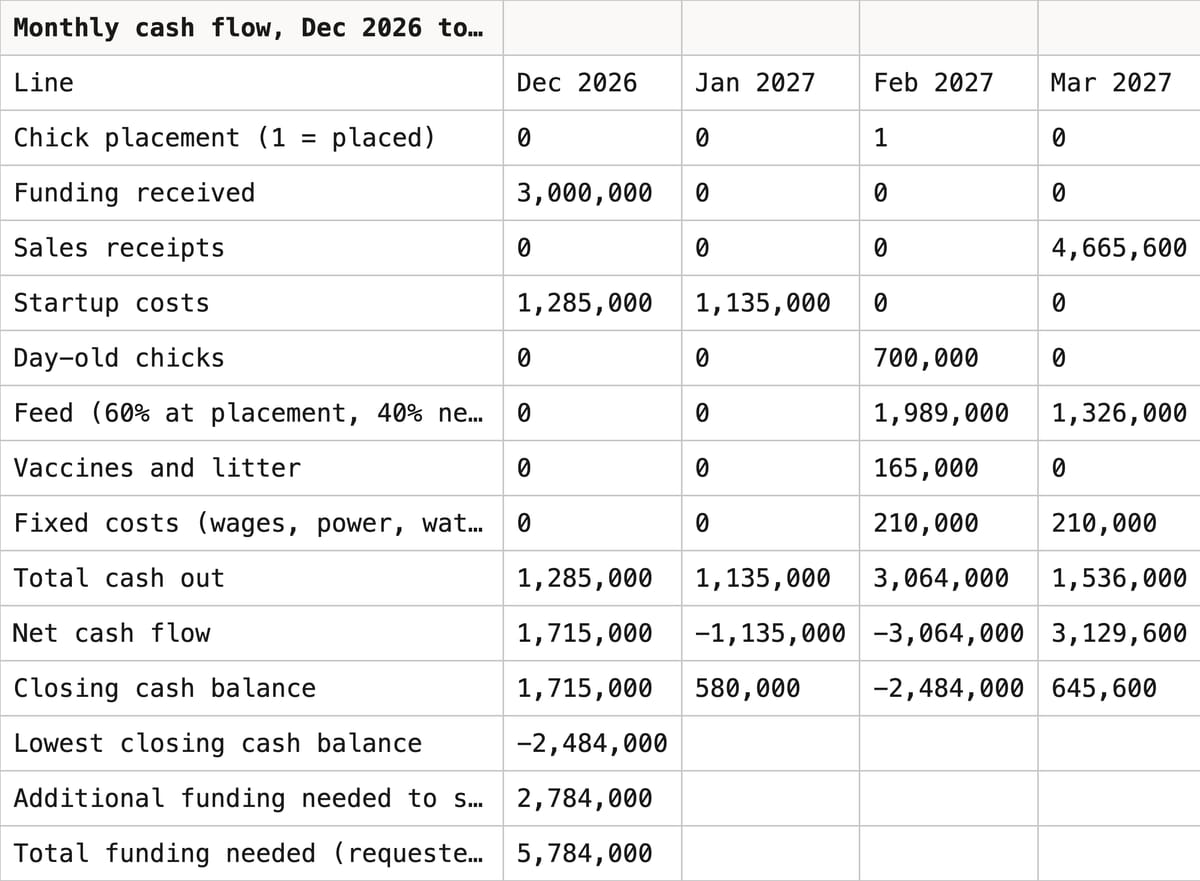
It is better to find that gap yourself than to have a loan officer find it. You can close it with a larger request, a smaller first flock, feed bought on credit, or a buyer who pays a deposit. Then look at the margin. The example's first year makes 393,600 naira on almost 28,000,000 in sales, and its sensitivity sheet shows that feed at 1,900 naira a kilo instead of 1,700 turns that into a loss of 1,946,400.
Every price in that workbook is marked as an estimate to verify. Swap in quotes from your feed mill, hatchery and buyers on the assumptions sheet and every other sheet updates. You can build the same kind of workbook for a shop with the AI Excel generator.
Register the business where lenders can check it
Registering gives the business a legal name and a registration number to put in your plan. Each country has one registry for this (checked October 30, 2026):
- Nigeria: the Corporate Affairs Commission registers business names and companies. Registration starts on its online portal.
- Kenya: the Business Registration Service registers businesses through eCitizen, where name reservation and registration are now one step.
- Uganda: the Uganda Registration Services Bureau registers business names and companies.
Put the registration number in your business description section. If you are not registered yet, say when you will be, and list the fee in your startup costs.
Finish it in an afternoon
A first draft is the slow part, and it no longer has to be. Answer the questions with your real numbers, then go through the draft with a pen. Replace any figure you cannot back with a quote from a supplier or a price you checked at the market, and ask in the same chat for whatever is thin: a sharper summary, a cheaper start, a second year with more birds.
Then read the summary out loud to someone who knows the business. If they can repeat back what you sell, what you need and how you will pay it back, the plan is ready to send.