askROI Blog
How to answer key selection criteria with STAR, with examples
How to answer key selection criteria for Australian public sector jobs: one STAR answer per criterion, a measurable result, and a pitch if the ad asks.
By askROI ·

Try it
Give askROI the criteria and one real example for each, and it writes STAR answers as a Word document. It asks for your examples first, so the answers are built on what you actually did.
Opens a new chat with a message you can edit before sending
Key selection criteria are the skills and qualities a job ad says you have to show, and the people reading your application score you against them, one by one. The way to answer them is one specific example per criterion, with a result you can measure. A list of duties won't do it.
Applications for the Australian Public Service, state governments, councils and universities often work this way. It takes longer than a cover letter, but the rules are clear once you've seen them.
What the APS itself says
The Australian Public Service Commission's guide Cracking the code (last updated February 2022, read 6 November 2026) is still the place to start for APS jobs. Three things from it:
- An application may ask for a statement against selection criteria, a short pitch, or answers to questions, along with your resume.
- It describes the STAR model as one way of presenting information against selection criteria. You don't have to use it.
- "If a word or page limit is set, make sure you stick to it." Limits differ from job to job, so go by the ad and not by a number you read online. The 250 words in our prompt is only a working length.
State governments, councils and universities set their own formats, so read the instructions in the ad and the position description first.
STAR, with one worked answer
STAR stands for Situation, Task, Action and Result. The APSC puts it like this: set the context, say what your role was, say what you did and how, then say what you achieved and how it relates to the job.
Spend most of your words on Action and Result. Readers can guess the context, and they can't guess what you did. Here's the shape in brief, using a made-up example:
- Situation: Front desk wait times averaged 14 minutes, with no extra staff available.
- Task: I had to bring waits down using the team we had.
- Action: I rebuilt the roster around when people actually arrived.
- Result: Over one quarter, average waits fell to 6 minutes, with no extra staff.
The last line does the work. A number, a before and after, or what changed for the people you served is what turns a claim into evidence.
Pitch or statements? The ad decides
If the ad asks for responses to each criterion, write one per criterion under its own heading. If it asks for a pitch or a statement, write one connected piece that covers the same ground in the order the ad lists it. Do what it asks, even if you've got a better version of the other kind ready. Someone is checking each application against the same instructions.
Three example answers
We gave askROI the prompt above, then three made-up examples for an APS5 administration role, all from a fictional regional council:
- Communicates with influence: moving three branch managers onto one shared leave form by showing that the old forms caused 40 payroll corrections a quarter, which then fell to 6.
- Works collaboratively: working with finance and records staff to clear 210 unfiled invoices in five weeks.
- Achieves results: the roster change above.
It came back as a Word document with a heading and a STAR answer for each criterion, between 214 and 235 words. Every number in it was one we'd given it, and it didn't add any.
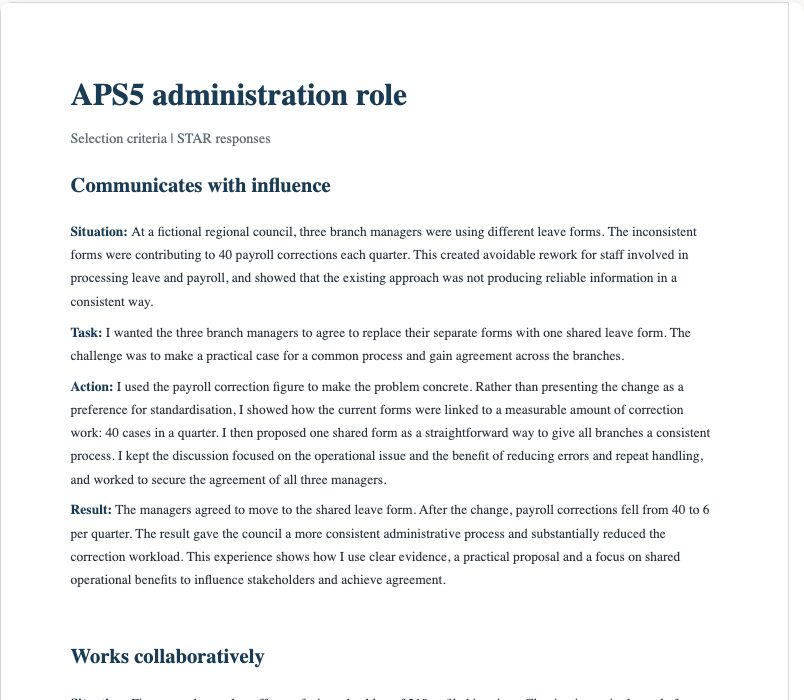
The answers are a good structure to edit, and they read a little stiffly in places. Put them in your own voice. The word "fictional" in the image is there because our test example said so, and yours won't have it. The file is an ordinary Word document, the kind the Word document generator makes, and the cover letter generator can draft a letter if the ad asks for one too.
Three mistakes that cost points
- Claims without a result. "I have excellent communication skills" gives the reader nothing to score. Say what you did and what happened next.
- Copying the ad's wording. Using the criterion's own terms helps a reader find the match. Repeating its description as if it were your experience doesn't.
- Going over the limit. It's the one instruction anyone can check at a glance, and the APSC's guide tells you to stick to it.
Pick your examples before you write a word, and use a different one for each criterion if you can. A reader who sees the same project three times starts to wonder if you've only done one thing.