askROI Blog
How to check an AI answer about tax, health or money
How to check an AI answer on tax, health or money: ask for the source, open the official page yourself, and compare the exact number, date and condition.
By askROI ·

Try it
Put one question to several AI models at once and see where they agree. The button asks about a figure you can check on the IRS website in under a minute.
Opens a new chat with a message you can edit before sending
You can check an AI answer in about a minute, and on anything to do with tax, health or money, it's worth the minute. Ask for the source, open the official page yourself, and compare the exact number, the date and the conditions.
You wouldn't be alone in doubting it. In a Pew survey, 76% of US adults who never use chatbots gave distrust of their accuracy as a reason. In the UK's public engagement survey, inaccurate information was the most common risk people named, at 74%. Yet in KPMG and the University of Melbourne's Australian snapshot, 57% of workers said they'd relied on AI output at work without evaluating its accuracy. (All checked 6 November 2026.)
Why answers go wrong
An AI answer sounds equally sure whether it's right or wrong, so the tone won't help you. The errors tend to fall into a few types:
- Out-of-date figures. Thresholds, rates and deadlines change every year, and a model may have learned last year's.
- The wrong country. Tax and health rules differ by country, and a question with no country in it gets whichever one the model assumes.
- Made-up citations. A model can name a page, a case or a study that doesn't exist, or that says something else.
- A missing condition. The number can be right and still not apply to you, because it only holds for a certain income, age or filing status.
The three-step check
- Ask for the source. Add "name the official page this comes from" to your question, or ask right after. If the answer can't name one, treat it as a starting point.
- Open the page yourself. Go to the official site, not a page summarizing it. Search the site directly if the link doesn't work, because a broken link is a warning sign.
- Compare three things. The exact number, the date or tax year it applies to, and the conditions attached to it. Any one of them can be off while the other two look fine.
For a pasted answer with several claims in it, the fact checker rates each one and links what decided it. You still open the links.
Where to check in each country
We checked each of these addresses on 6 November 2026.
- US: IRS for tax, HealthCare.gov for health coverage, CFPB for money and credit.
- Canada: CRA for tax, Health Canada for health, the Financial Consumer Agency of Canada for money.
- UK: GOV.UK and HMRC for tax, the NHS for health, Citizens Advice for money and rights.
- Australia: the ATO for tax, healthdirect for health, Moneysmart for money.
Asking several models at once
A single model can be confidently wrong, and you won't see it. Ask three and at least you can see when they disagree. That's what Model Council does: one message goes to three models from different labs, a judge that wrote none of the answers compares them, and you get one final answer with the agreements and disagreements laid out.
We sent the Try it question and all three answered. The final answer said $16,100, and that matches what the IRS announced for tax year 2026 when we read the release ourselves on 6 November 2026.
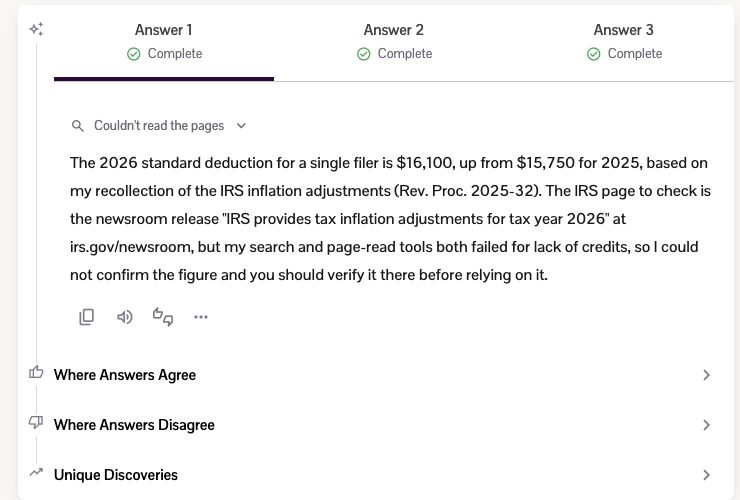
Look at what the first answer says, though. On the machine we ran it on, web search wasn't available, and the model said so: it gave the figure from memory and told us to verify it before relying on it. That's the behavior you want. It also shows why agreement isn't proof. Three models can share the same out-of-date figure, so a council tells you where to look harder, and the official page settles it.
When to ask a professional instead
Checking a fact is one thing, and deciding what to do about your situation is another. Talk to a person when:
- The answer depends on your circumstances, such as a tax position with more than one reading, or a contract you're about to sign.
- It's about a symptom or a medicine. Use the official pages to prepare your questions, then ask a doctor or pharmacist. If it's urgent, call your local emergency number.
- The cost of being wrong is high, like a large payment, a legal deadline or a diagnosis.
An official page tells you the rule. A professional can tell you how it applies to you, and they answer for that advice. Keep the AI for the first draft of your questions, and let the official source have the last word.