askROI Blog
How to humanize AI text so it sounds like you
How to humanize AI text so it sounds like you, what AI detectors actually measure and why they misfire, and the school rules to check first.
By askROI · · Updated

Try it
Give askROI a paragraph you drafted with AI's help and it rewrites it to sound like a person wrote it, keeping every fact and number, then tells you what it changed. The button fills in a sample work update; swap in your own paragraph before you send.
You asked an AI for a first draft and it came back smooth, polite and obviously not yours. Readers notice that before any detector does. This guide shows what gives an AI draft away, what detectors really measure, and how to humanize AI text so it sounds like you without breaking your school's rules.
Six things that make a draft read as AI
AI drafts lean on the same handful of habits. Here are six of them, with what to write instead:
- A filler opener. "In today's fast-paced world, our team embarked on a journey..." Start with what happened: "We rebuilt how new hires get set up."
- Buzzwords. Leverage, pivotal, foster, delve, landscape. Say use, key, build, look at, field.
- "Not only X, but also Y." "It not only saved time but also fostered collaboration." Say the result: "It cut five days from every new hire's first two weeks."
- Groups of three. "Faster, smarter and more efficient." Keep the one benefit you can prove.
- Even rhythm. Every sentence about the same length. Write a short sentence. Then a longer one that explains why.
- A hollow closer. "Moving forward, we remain committed to..." Stop at your last real point.
None of these is wrong on its own. A draft that stacks all six reads like a template, because it is one.
What detectors measure, and why they misfire
GPTZero's help page describes the two measures its early versions used: perplexity, "a measure of how likely an AI model would have chosen the exact same set of words," and burstiness, how much that varies across a document. GPTZero says it moved to a deep learning model in autumn 2023, but the old measures explain the basic idea: text that is predictable and evenly paced looks machine-made (checked October 30, 2026).
They also get it wrong. OpenAI withdrew its own classifier on July 20, 2023, "due to its low rate of accuracy". In OpenAI's tests it caught 26% of AI-written text and labeled 9% of human writing as AI. A Stanford study of seven detectors found they labeled 61% of essays by non-native English writers as AI-generated on average, while getting US eighth graders' essays almost all right. The authors point to vocabulary: writing in a second language often uses a narrower range of words, which reads as predictable. When they simplified the word choices in the eighth graders' essays, the detectors started flagging those too.
So no humanizer can promise a pass, and askROI does not. Schools treat the scores with care too: the University of Sydney says an AI detector score "would not be the only evidence" in an academic integrity case.
Rewrite it yourself in five passes
Work through these in order:
- Delete the first and last sentences if they could open or close any document.
- Swap every general claim for the fact behind it. "Improved efficiency" becomes "cut onboarding from 14 days to 9."
- Replace AI vocabulary with plain words. Leverage is use. Pivotal is key, or nothing.
- Read it aloud and vary the length. If every sentence takes one breath, split one and join two.
- Add one thing only you know: your example, your number, your reason for caring.
Let askROI do the first pass
The AI Humanizer runs that cleanup for you. It looks for about 30 patterns AI writing is known for, including the six above. It keeps every fact, name, number and quote as you wrote them, keeps roughly the same length and tone, and ends with a short note on what it changed so you can check its work.
Here is what came back from the Try it prompt above, sent in Standard mode. It took under 20 seconds and 5 credits:
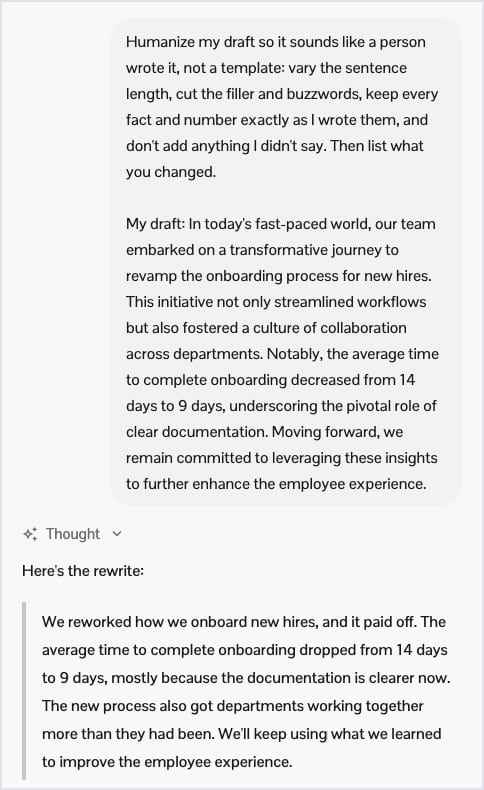
The opener, the "not only... but also" line, the buzzwords and the mission-statement closer are gone, and the 14 days to 9 days now sit in the second sentence where a reader sees them. Under the rewrite, askROI listed each change and confirmed that no number or claim was added.
Read the rewrite anyway. "Mostly because the documentation is clearer" says a little more than "the pivotal role of clear documentation" did. If that is true, keep it. If not, put your own words back. A tool can strip the tells, but only you know whether the claims are right.
If it's for a class, follow your school's AI rules
Humanizing your own draft is editing. Handing in text that someone, or something, else wrote as your own is not, however human it sounds. Schools draw the line in different places, so check yours:
- The University of Sydney lets each unit outline say whether AI is allowed for an assessment, asks you to acknowledge any AI use, and treats unpermitted or unacknowledged use as a possible academic integrity breach.
- The University of the Philippines Open University asks students to "declare and properly cite AI-generated content" under guidelines it released in January 2024.
When in doubt, ask your teacher before you use AI on graded work, and say how you used it.
Readers trust writing that sounds like a person with something to say. Start from your own facts, cut what you would never say out loud, and let a tool take the first pass, not the last word.