askROI Blog
How to write an ILAW lesson plan under DepEd Order 16, s. 2026
The four parts of an ILAW lesson plan under DepEd Order 16, what goes in each, and what DepEd lets AI help with.
By askROI · · Updated

Try it
Make the teaching decisions yourself, then let askROI type them up as an ILAW lesson plan. It sorts your notes into the four parts, cleans up the wording and gives you a Word document, with Reflections left blank for after class. The button fills in a sample Grade 7 Science lesson; swap in your own notes before you send.
From the second term of school year 2026 to 2027, the ILAW lesson plan is the standard in Philippine public schools. DepEd Order No. 016, s. 2026, signed on June 4, 2026, cuts the lesson plan down to four parts and tells offices to stop asking for extra forms (checked against the signed order on October 30, 2026).
This guide covers what goes in each part, how much detail you need, and the rule that matters most if you use AI: the teaching decisions have to be yours.
ILAW replaces the DLL and the DLP
DO 16 repeals DepEd Order No. 42, s. 2016, the policy behind the Daily Lesson Log (DLL) and the Detailed Lesson Plan (DLP). In their place is one lesson plan, the same for new and experienced teachers. It applies to all public elementary and secondary schools, DepEd community learning centers, ALS providers and the basic education units of state and local universities and colleges. Private schools are encouraged to adopt it.
You can keep using the DLL or DLP format until the end of the first term of SY 2026 to 2027. Full use of ILAW starts in the second term.
The four parts of an ILAW lesson plan
ILAW stands for Intentions, Learning Experience, Assessing Learning and Ways Forward. Here is what the order puts in each part:
| Part | What goes in it |
|---|---|
| Intentions | The learning competencies for the session, unpacked, clustered or sequenced into clear objectives that fit your learners and your time. |
| Learning Experience | Your learning resources, a short pre-lesson activity, the lesson flow, and chances to connect the lesson to other subjects or to local life. |
| Assessing Learning | Formative checks during the session, so you can adjust while you teach. |
| Ways Forward | Your reflection after the session, next steps such as reteaching, remediation or enrichment, and learning that continues outside class. |
Annex B of the order shows one way to lay this out: a header with lesson title, learning area, teacher, grade and section, number of sessions, references and a line for declaring AI use, then the four parts. The order calls it "only a reference tool". What counts is that the four parts are present and agree with each other: a plan is sufficient "when the learning intentions, learning experience, assessment approach, and ways forward are evident and aligned."
Write as much detail as the lesson needs
ILAW drops the old split between detailed plans and lesson logs. The amount of detail follows the situation. Write more when the content, the learners, the strategy or the tools are new to you. Write less as you gain confidence, and use the space for notes on what worked.
The order also limits what others can ask of you. Regional offices, division offices, schools and learning centers may not require extra or expanded templates, supplementary forms or documentation beyond the four parts. Your division may still send a memo on how to roll it out, so read it, but the four parts are the standard.
What DepEd lets AI do in a lesson plan
This is the part to read twice. The order says "fully AI-generated lesson plans shall not be allowed," and it sorts AI use into three categories:
- Prohibited: defining learning objectives, unpacking competencies, designing learning experiences and instructional strategies, or making critical judgments in response to learner needs.
- Limited: rephrasing, organizing or refining text, only after you have made the ILAW decisions and talked them through with co-teachers or instructional leaders. You review and adapt whatever comes back.
- Guided: checking grammar and spelling, making wording clearer, formatting and translating.
Pick a task to see where it falls:
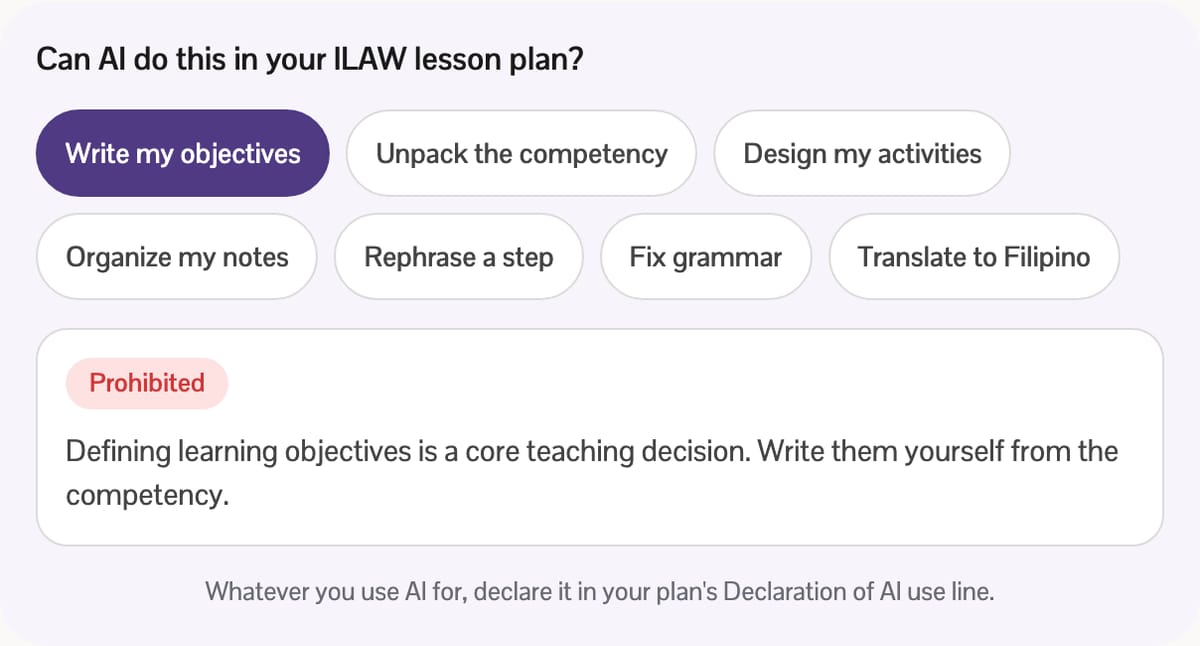
Whatever you use, declare it. Annex B has a Declaration of AI use line where you say how AI was used, following DepEd Order No. 003, s. 2026.
That leaves askROI a clear job: the Limited and Guided work. Give it the decisions you already made and it organizes them into the four parts, tightens the wording, translates into Filipino if you ask, and lays it out as a file with the AI Word document generator. askROI's AI lesson plan generator writes complete plans from a topic, which suits a tutor or a class outside DepEd's rules. For a public school ILAW plan, that would be the prohibited kind.
A finished plan from askROI
This is what came back from the Try it prompt above, sent in Standard mode: a Word file in under two minutes, for 17 credits.
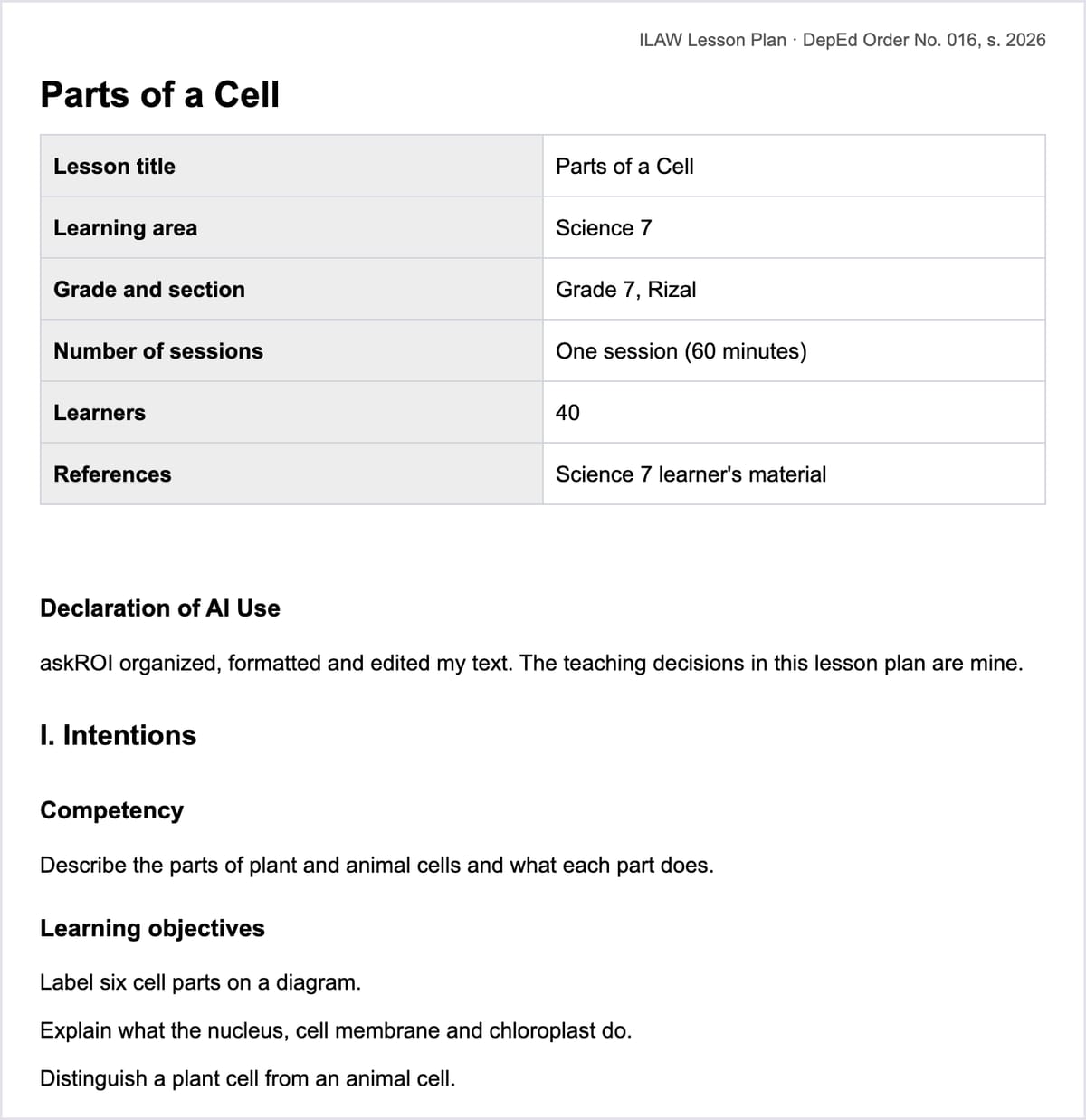
The competency and the objectives are the ones from the notes. The only change to them is wording: "tell a plant cell from an animal cell" became "Distinguish a plant cell from an animal cell." Learning Experience became a table with the minutes for each step, Assessing Learning lists the three checks, and Reflections under Ways Forward is empty, waiting for after class.
askROI also listed what to check before printing: that "Rizal" is the section and not the school, that "Science 7" is the label your school uses, and that it had not read the order itself, so the headings were worth comparing against it. The table earlier in this guide is that comparison.
What the rubric checks
Annex A is a self-check rubric: you answer Yes or Not yet for each line and note what would make it better. The order says it is for reflection and coaching, not a compliance checklist. Three of its lines are worth reading closely:
- Intentions are clearly stated. Copying the competency word for word is not the same as unpacking it into objectives you can see learners meet in one session.
- Assessment is integrated throughout the session. One quiz at the end does not tell you who got lost in the first ten minutes.
- Ways Forward is actionable. The reflection and the next steps come from what happened in the room, so write them after the lesson, not before.
ILAW asks for less paperwork and more thinking. Do the thinking yourself, keep a few notes while you teach, and let a tool do the typing and the formatting.