askROI Blog
ChatGPT prompts for real estate agents: listings, follow-ups and open houses
ChatGPT prompts for real estate agents that write fair housing safe listings, disclosed photo edits, showing follow-ups and open house posts from your facts.
By askROI ·

Try it
The button asks askROI for a 150-word listing description and three open house posts for a made-up bungalow. Swap in your own listing's facts and send it.
Opens a new chat with a message you can edit before sending
These ChatGPT prompts for real estate agents cover the writing you do every week: listings, photo captions, follow-ups and open house posts. Most agents have tried AI by now. In the National Association of Realtors' 2025 Technology Survey, 68% said they had used AI in their business and 46% said they use AI-generated content such as listing descriptions. The same share, 46%, said AI had made no noticeable difference to their business.
The prompts below are built to close that gap. They follow three rules: describe the home, never the buyer you picture in it; disclose any photo you staged or changed; and give the AI facts (rooms, upgrades, distances), not adjectives. If you are looking at AI for real estate agents to save time on the weekly writing, these are the jobs where it pays off. Every source in this post links to the original, and we checked each one on November 6, 2026.
Describe the home, never the buyer
The federal Fair Housing Act makes it unlawful to publish a notice, statement or advertisement for the sale or rental of a home that "indicates any preference, limitation, or discrimination" based on race, color, religion, sex, disability, familial status or national origin (42 U.S.C. 3604(c); HUD's overview of the Act). HUD's rule spells out that this covers "words, phrases, photographs, illustrations, symbols", and that written notices include flyers, brochures, signs and banners (24 CFR 100.75). Realtors have a wider list: Article 10 of the NAR Code of Ethics adds sexual orientation and gender identity.
That is why the Try it prompt says "describe the home and the area, not who should buy it." Left alone, a model reaches for lines like "perfect for a young family", which describes a buyer, and familial status is a protected class. Facts never need a buyer attached: three bedrooms, a fenced yard, a park two blocks away. Let the reader decide whether it suits them.
Here is what askROI wrote from the Try it prompt, for a home we made up. The listing came back at exactly 150 words.
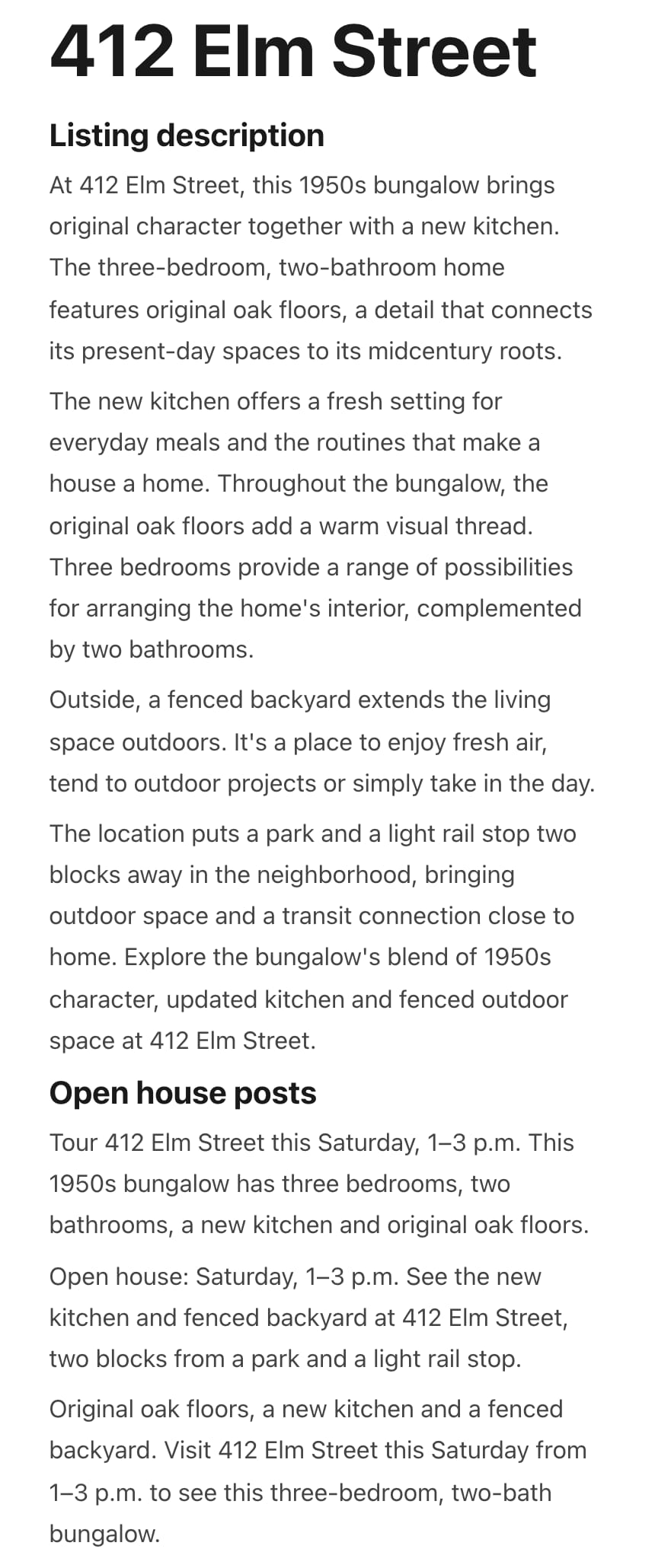
Used as a real estate listing description generator, it only knows what you tell it. Every fact came from the prompt, and nothing names a buyer. It also shows what happens when the facts run out: "the routines that make a house a home" is filler. Give it more (the year the kitchen was redone, the park's name) and the filler goes away. Check every fact before it goes live, because you are the one publishing it.
Virtual staging and photo edits: say what you changed
The NAR Code doesn't name virtual staging, but Article 12 says Realtors "shall present a true picture in their advertising," and Standard of Practice 12-10 forbids "misleading images" and manipulating listing content "in any way that produces a deceptive or misleading result" (2026 Code).
California has made disclosure law. Since January 1, 2026, Business and Professions Code section 10140.8 requires a clear disclosure when a listing image has been changed in a way that alters how the property looks, including changes made with AI, and the original, unaltered image has to be available to consumers (California Department of Real Estate advisory, March 17, 2026). Check your own state and MLS rules before you post.
Furnishing an empty living room shows furniture that won't be there. Label the staged photo, keep the empty one in the listing, and never change what stays with the house: walls, floors, windows, the view.
The AI photo editor handles staging and fixes like brightening a dim room. Attach the photo, say what to change and what has to stay exactly the same. Its virtual staging starter asks for the walls, windows, floor and light to stay as they are, the right default for a listing.
Follow up after a showing with one real detail
A follow-up works when it proves you listened. Write down what the buyer said at the showing (the room they lingered in, the question they asked) and ask for a short message that answers it and offers one next step. "Liked the office, asked about the roof" is enough; leave their finances and family out of what you paste.
Open house posts and flyers from the same facts
Once the listing is right, everything else is a rewrite of the same facts. The three posts above reuse the address, the hours and a few features, and invent nothing. For more, the AI social media post generator writes a version for each platform within its character limit, with hashtags, image briefs and alt text, plus a one-week posting calendar. For the printed version, the AI flyer maker turns the date, time, address and how to get in touch into a print-ready PDF. The same advertising rules apply to both: HUD's rule names flyers and signs alongside ads.
8 prompts to copy
Fill the brackets with your own facts.
- Listing description: "Write a [length]-word listing description for [beds, baths, type, year] at [address] with [three to five features] and [two nearby places with distances]. Describe the home and the area, not who should buy it, and follow fair housing rules."
- Fair housing check: "Read this listing and flag any phrase that describes a type of buyer instead of the property, or that could read as a preference about who lives there. Suggest a factual replacement for each: [paste listing]."
- Virtual staging: attach the photo, then "Furnish this empty [room] in a [style] style with [three or four pieces]. Keep the walls, windows, floor and light exactly the same."
- Staging disclosure: "Write a one-line caption for a virtually staged photo of the [room] that says it is digitally staged and that an unstaged photo is in the listing."
- Showing follow-up: "Write a short follow-up email to a buyer who saw [address] today. They liked [detail] and asked about [question]. Answer it with [fact] and offer [next step]. Under 100 words."
- Open house reminder: "Write a text message reminding people who registered for the open house at [address] on [day, time] about parking at [where]. Under 40 words."
- Open house posts: "Write three short posts for an open house at [address] on [day, time], each leading with a different feature: [features]."
- Seller update: "Write a weekly update for my sellers at [address]: [showings, feedback, online views]. Plain, honest, and end with one recommendation."
Outside the US
Rules differ by country, state and province, so check with your regulator.
- Canada (Ontario): the Real Estate Council of Ontario's guidance on using AI tells agents to make sure virtual staging or AI changes "accurately reflect permanent features" and to "clearly label any digitally altered images".
- Australia (New South Wales): NSW Fair Trading's advertising guidelines say agents must not change a property's appearance "by digitally removing or adding features", while adjusting lighting only to make up for poor lighting may be acceptable.
- United Kingdom: Listings fall under the Digital Markets, Competition and Consumers Act 2024, which bars traders from leaving out material information, meaning all the information an average buyer needs to make an informed decision. The government says no sector-specific list has been produced since the Act took effect and earlier attempts at sector guidance were unsuccessful (Material information in property listings, consultation outcome updated June 19, 2026, checked November 6, 2026). National Trading Standards' earlier material information guidance (November 30, 2023) listed facts such as the price, council tax band, tenure, property type, rooms with measurements, utilities and parking. Treat that as a starting point for your prompt, then add anything else a buyer of that property would need to know.
The facts are the listing
The model writes fluent sentences for free. What it can't do is know your listing: the year the roof was done, the park's name, what the buyer asked at the door. Bring those, keep the buyer out of it, label what you changed, and the writing is the easy part. You'll need a free askROI account to send a prompt; if you're signed out, askROI asks you to sign in and keeps the prompt you were about to send.