askROI Blog
How to prepare a scheme of work, with a CBC template
How to prepare a scheme of work for the term from the KICD curriculum design: the CBC columns, the weeks, and a chat that builds yours.
By askROI ·

Try it
Attach your curriculum design, then send. The button opens a chat with a Grade 4 Mathematics request already filled in; add the design PDF with the attach button before you send, and change the grade, subject and weeks to yours. You need a free askROI account, and making the Word file uses credits.
Opens a new chat with a message you can edit before sending
A scheme of work is the term's plan for one subject: which sub-strand you teach in which week and lesson, what learners should be able to do by the end, and how you will check. In Kenya it is also a document you are expected to keep. The Teachers Service Commission's checklist of professional documents lists "Approved Schemes of work/work plans" among the records teachers "must" prepare and keep up to date (TSC checklist of professional documents, checked 30 October 2026).
The fastest way to get it right is to build it from the official curriculum design, not from memory. The lesson plan template works the same way for single lessons. Below: how a scheme differs from a lesson plan, the columns schools check, how to take them from the KICD design, how to fit the weeks, and what changes in Uganda and Nigeria.
A scheme of work plans the term, a lesson plan plans one lesson
The scheme comes first. It spreads the term's sub-strands across the weeks, so you can see on one page that the term's content fits the time you have. A lesson plan then takes one row of the scheme and plans that lesson in detail: the introduction, the activities, the questions and the check at the end.
That is why the scheme should be built before the term starts and kept current as you go. When a week is lost to an event or a closure, you move rows in the scheme, and the lesson plans follow.
The columns your school will check
KICD's curriculum designs set out each strand in a table headed Strand, Sub-Strand, Specific Learning Outcomes, Suggested Learning Experiences and Suggested Key Inquiry Question(s) (KICD Grade 4 designs, checked 30 October 2026). A scheme of work keeps those and adds the planning columns around them. KCA University's School of Education uses this order in its CBC scheme of work template for student teachers (KCA University, Scheme of Work (CBC), checked 30 October 2026):
- Week
- Strand
- Lesson number
- Sub strand
- Specific learning outcomes
- Key inquiry questions
- Learning experiences
- Learning resources
- Assessment
- Remarks
Remarks stays blank when you write the scheme. You fill it in as the term runs: taught, carried over to next week, or what to change. Schools differ on the exact headings, so if your head of department hands out a template, use theirs.
Take the strands from the KICD design
Every row of the scheme should trace back to the design. Copy the strand and sub-strand names exactly, and take the specific learning outcomes and key inquiry questions from the same row of the design table rather than writing your own.
The Grade 4 Mathematics design has four strands: Numbers, Measurement, Geometry and Data Handling. Its lesson allocation gives Mathematics 5 lessons a week at upper primary, out of 35 lessons in total. Each sub-strand also carries a suggested number of lessons, which tells you how many rows it gets.
KICD posts the current designs on its Grade 4 designs page, where they open in a viewer, and sells printed copies through the KICD bookshop. If your school shares the design as a PDF, attach that to the Try it chat. If you only have the viewer, paste the term's sub-strands and their outcomes into the chat instead.
Fit the sub-strands into the term's weeks
Count the teaching weeks before you place a single row. Start from the term dates in the Ministry of Education's school calendar circular for your year, then take out opening and closing days, the half-term break and any assessment week.
Multiply what is left by your weekly lessons. Twelve weeks at five lessons a week gives 60 lessons. Add up the suggested lessons for the sub-strands in design order, and stop where the term runs out; the rest opens next term's scheme. If the total runs over, shorten practice lessons inside a sub-strand rather than dropping an outcome.
What askROI made from the Try it prompt
We sent the Try it prompt as a made-up teacher, with a KICD Grade 4 Mathematics design attached. Because the current design only opens in KICD's viewer, we attached an earlier print of the same 2024 revision, a draft that KICD once offered as a download. askROI read the PDF, worked out the lesson counts, and returned a 10-page Word file in A4 landscape: 60 lessons, 12 weeks of 5, in the ten columns the prompt named, with Remarks left blank. Here are the first six columns of its first two lessons:
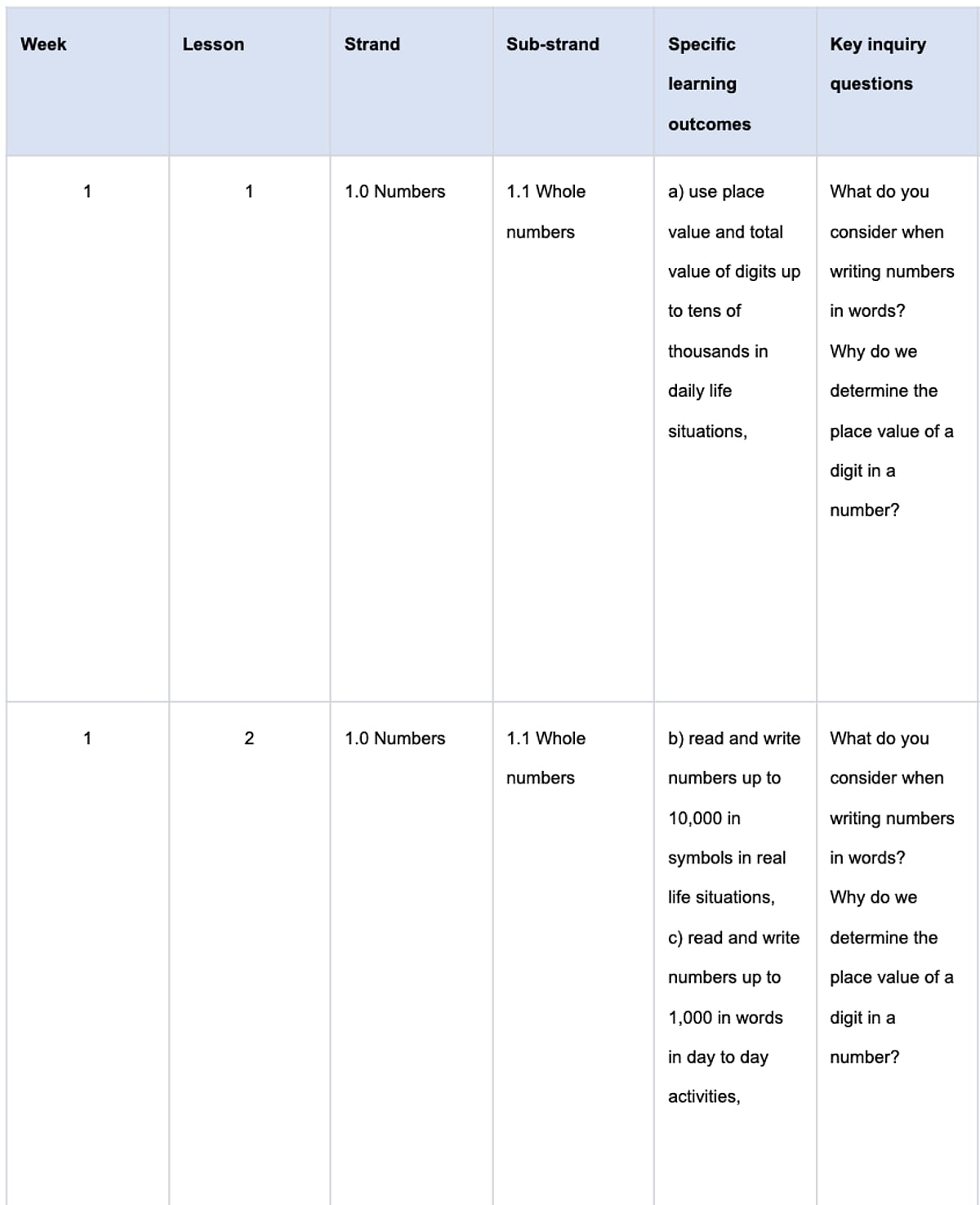
Term 1 covered Strand 1, Numbers, from 1.1 to 1.8, with the outcomes and key inquiry questions in the draft's wording. It also told us what to check. The draft gives no lesson count for 1.1 Whole Numbers, so askROI chose 6 to make the term total 60. It noticed the PDF was a draft print and told us to confirm it was the version we teach from. And the pairing of outcomes to individual lessons inside a sub-strand was its own split, not the design's. The run used 68 credits.
That warning mattered. The current design gives 1.1 Whole Numbers 10 lessons and rewords some outcomes and questions, so a scheme built from it splits the term differently. Attach the design your school teaches from, and the rows follow that version.
Uganda and Nigeria: the same idea, different documents
Uganda. The NCDC lower secondary syllabuses set out each topic in three columns (learning outcomes, suggested learning activities and sample assessment strategies), with a competency statement and a number of periods per topic, grouped by term (NCDC Lower Secondary Mathematics Syllabus, checked 30 October 2026). Build the scheme from those columns, with the periods setting how many weeks each topic gets.
Nigeria. The NERDC Basic Education Curriculum gives, for each theme, "the contents, performance objectives, activities for both teachers and learners, teaching and learning materials and evaluation guide" (NERDC curriculum, Primary 4 to 6 English Studies, checked 30 October 2026). Spread those contents across the term's weeks the same way. If your state or school issues its own scheme of work, follow its week order.
In all three countries the rule is the same. A scheme of work built from the official document holds up when someone checks it against the curriculum, and it saves you rebuilding the term every time something moves.